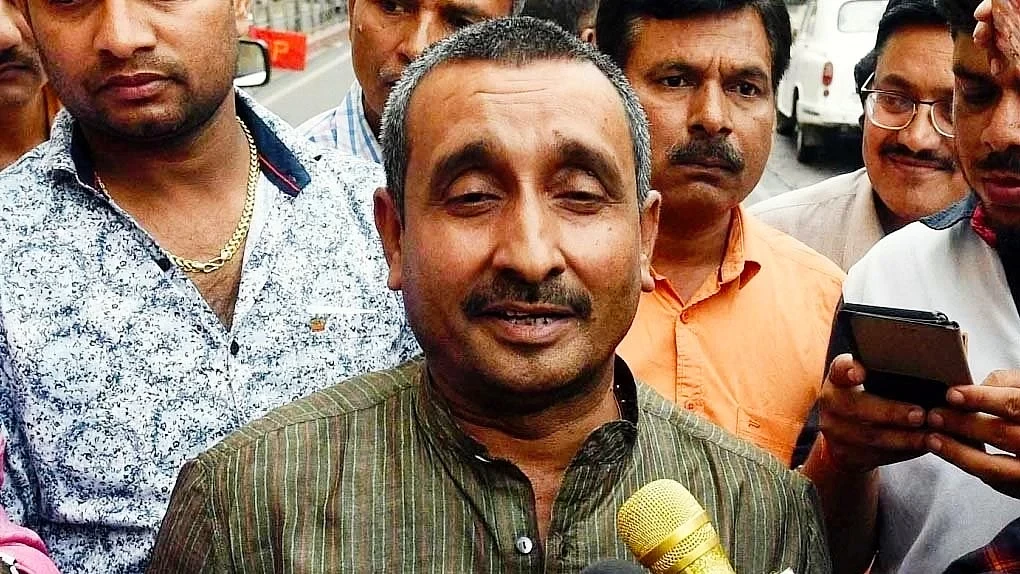
The Delhi High Court on Tuesday suspended the life sentence of former Bharatiya Janata Party (BJP) legislator Kuldeep Singh Sengar, convicted in the high-profile 2017 Unnao rape case, and granted him bail pending appeal, drawing widespread criticism from rights activists, political leaders and the victim’s family. Sengar, who had been serving a life term after being convicted of raping a minor and other related offences in December 2019, saw his sentence temporarily halted by a division bench of the Delhi High Court comprising Justice Subramonium Prasad and Justice Harish Vaidyanathan Shankar. The court’s order allows him bail while his appeal against conviction and sentence is being heard.
Under the terms of the bail order, strict conditions have been imposed: Sengar must furnish personal bonds and sureties, remain within Delhi, avoid entering within five kilometres of the survivor’s residence, and refrain from contacting, intimidating or influencing the survivor or her family. He is also required to surrender his passport and report to the police every Monday during the bail period. Any breach of these conditions could lead to immediate cancellation of his bail.
Despite being granted this bail relief, Sengar remains incarcerated because of a separate 10-year sentence he is serving in connection with the custodial death of the rape victim’s father - a linked but distinct case that has its own legal proceedings. The high court’s decision ignited protests in New Delhi, where the rape survivor and her mother, accompanied by activist lawyer Yogita Bhayana, staged a demonstration near India Gate on Tuesday evening. They were detained by security forces, and dramatic scenes unfolded as paramilitary personnel blocked them from addressing the media, later forcing the elderly mother off a moving bus in what rights groups and opposition leaders described as manhandling.
The survivor, visibly distressed by the court’s order, described the bail as “kaal (death)” for her family and announced plans to move the Supreme Court challenging the suspension of Sengar’s sentence. Her sister, too, voiced deep concern for the family’s safety, saying they felt unsafe since the bail order. Political reactions to both the bail order and the treatment of the victim’s family have been swift. Congress leader Rahul Gandhi condemned the sequence of events, saying India was becoming a “dead society” when survivors are treated as criminals and justice appears out of reach. He argued that survivors deserve protection, dignity and assurance of safety - not helplessness and fear.
The incident also drew criticism for the conduct of authorities who restrained the protest, especially after the survivor’s elderly mother was forced off a bus during the removal process. Social media footage and news reports highlighted the absence of female officers during the detention and alleged rough handling of the protesters by CRPF personnel. Legal experts note that suspension of sentence and interim bail in appeals is not unusual in the Indian judicial system; however, in cases involving violence against women and minors, such decisions are seen as particularly sensitive due to concerns about victim safety and public perception of justice. The Delhi High Court’s order in this case has intensified debates over judicial discretion and survivor rights in high-profile criminal matters.
The Unnao case itself has a long and troubled history, beginning with the alleged rape of a minor in 2017, followed by the death of her father in custody, widespread protests and political controversy that spanned years and drew national attention to issues of political influence, victim protection and accountability.