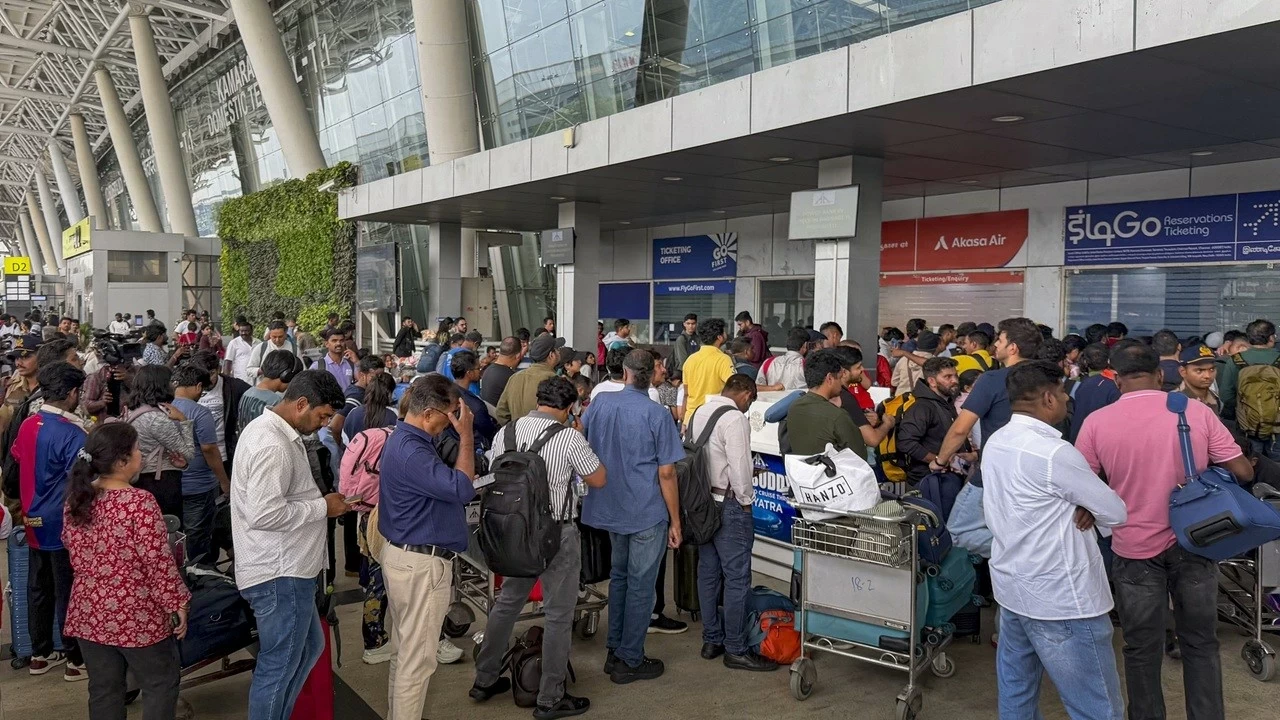
The Delhi High Court on Wednesday strongly criticised the Union government and aviation regulators for their handling of the recent IndiGo flight crisis, which triggered widespread cancellations and a dramatic spike in airfares, leaving thousands of passengers stranded nationwide.
A bench of Chief Justice Devendra Kumar Upadhyaya and Justice Tushar Rao Gedela made the remarks while hearing a PIL seeking an independent judicial probe into the disruption.
The bench questioned how the situation was allowed to spiral and why neither the Ministry of Civil Aviation nor the Directorate General of Civil Aviation (DGCA) took timely corrective action. “In case any airline failed to adhere, what is the provision available to you? Are you helpless? What action could you take against them for failure to adhere?” the Chief Justice asked.
When the petitioner’s counsel admitted he was “not fully aware” of the statutory framework governing the aviation sector, the court expressed displeasure, remarking that a PIL cannot be filed without understanding the law.
The bench said it was concerned not only with the chaos at airports but also with the broader economic impact. Justice Gedela noted that passengers had faced significant “harassment and trouble”, while the Chief Justice remarked: “Why did such a situation precipitate? Who is responsible? It is not only about passengers stranded at airports; it is a loss to the economy.”
The court also criticised the sharp rise in ticket prices following the cancellations, observing that fares on routes usually priced around ₹5,000 had surged to ₹30,000–35,000. “If there was a crisis, how can other airlines be permitted to take advantage? How can it go to 35–39k? How can this happen?” the bench asked.
Additional Solicitor General Chetan Sharma told the court that the ministry intervened within two days of the crisis and imposed temporary fare caps. He attributed the disruption to IndiGo’s delayed implementation of the revised Flight Duty Time Limit (FDTL) norms, introduced to reduce pilot fatigue. The ASG said the norms had been phased in since July and that while smaller airlines complied, IndiGo and Air India repeatedly sought extensions. He added that IndiGo had been issued a show-cause notice and had “apologised profusely”.
The DGCA informed the court that the updated FDTL norms had been under consultation for over ten years. Despite exemptions and a staggered rollout, a shortage of pilots reportedly emerged once the final phase took effect on 1 November, leading to cancellations within days.
The Chief Justice questioned whether previous duty rosters had compromised safety: “Tell us when a pilot is to do two landings at night and is doing six? This means he is compromising safety.” The bench asked what action the DGCA could take if an airline failed to hire enough pilots to comply with regulatory requirements.
The court also sought details of any compensation plan for affected passengers. While dictating its order, the bench said it appreciated the ministry’s and DGCA’s actions after the crisis erupted, but stressed that the authorities should never have allowed “lakhs of passengers to be stranded unattended at airports”.
The bench observed that such disruptions hamper economic productivity in an era when rapid mobility is essential. It directed the Centre and DGCA to continue corrective measures, ensure that airlines maintain sufficient pilot strength to meet FDTL norms, and facilitate “appropriate compensation” for stranded travellers.
The court said it would not comment on internal issues within IndiGo, noting that a committee was already examining the matter and would hear the airline’s version. It directed that the inquiry report, if ready, be submitted in a sealed cover.
The case will next be heard on 22 January 2026. Before rising, the bench told IndiGo’s counsel: “It is not only with respect to cancellation, but also other damages and sufferings. We will pass an order directing you to make compensation.”