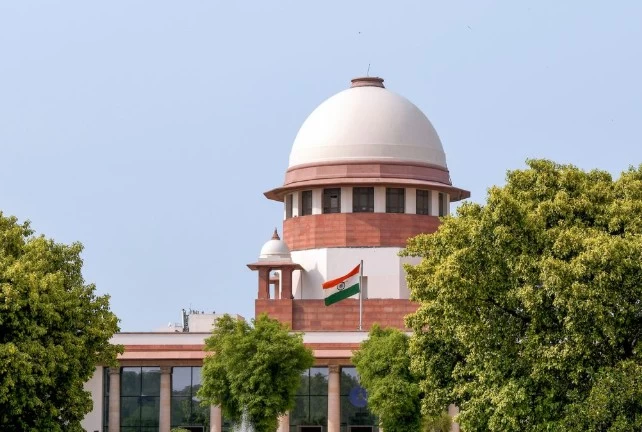
The Supreme Court on Monday stayed several contentious provisions of the Waqf (Amendment) Act, 2025, while refusing to stay the law in its entirety. A bench led by Chief Justice of India Bhushan R. Gavai, along with Justice A.G. Masih, ruled that several contentious clauses of the Act must remain stayed until petitions challenging its constitutionality are finally decided. However, the court underlined that the statute as a whole would continue to operate, noting that legislation enjoys a “presumption of constitutionality”.
The court stayed provisions granting district collectors sweeping authority to decide whether property claimed as waqf in fact belongs to the government. Such powers, the bench said, would undermine the separation of powers and lead to arbitrary outcomes. “The Collector cannot be permitted to adjudicate the rights of personal citizens, and this will violate the separation of powers. Till adjudication happens by the tribunal, no third-party rights can be created against any party,” the court observed.
The judges made it clear that any determination over waqf property must remain subject to adjudication by specialised waqf tribunals and, if required, review by the relevant high court.
Another provision requiring that only a practising Muslim of at least five years could dedicate property as waqf was also stayed. Chief Justice Gavai remarked, “Without any mechanism, it will lead to an exercise of arbitrary power.” However, he clarified that this clause would take effect only after state governments framed rules to determine how adherence to Islam is to be established.
The bench also intervened on the composition of waqf bodies. It directed that no more than three non-Muslim members be included in any state waqf board, and no more than four in the Central Waqf Council. The court further suggested that chief executive officers of waqf boards should preferably be Muslims, even though the amended Act does not mandate this.
At the same time, the court upheld the requirement that all waqf properties be registered on a centralised digital portal. It refused to interfere with the Union government’s notification mandating that properties be recorded on the UMEED (Unified Waqf Management, Empowerment, Efficiency, and Development) portal within six months.
According to the Ministry of Minority Affairs, the portal is intended to ensure transparency by creating a digital repository of property details, including photographs and geotagged locations.
During earlier hearings, senior advocates Kapil Sibal, Rajeev Dhavan and Abhishek Manu Singhvi had argued that the law unfairly burdens the Muslim community and threatens to extinguish waqf properties historically recognised through usage or oral tradition. Sibal had told the bench, “It is the failure of the state to carry out their job from 1954 to 2025, and due to their failure, a community is being punished.”*
The Solicitor General, Tushar Mehta, defended the amendments as essential reforms to enhance accountability and prevent misuse. He contended that allowing “any person” to dedicate waqf, as permitted by the 2013 amendment, was conceptually flawed. “How can waqf, which is an Islamic concept, be available for non-Islamic persons?” he asked.
Another contentious provision barring the creation of waqf on tribal land also came under scrutiny. The government said the measure was to protect vulnerable communities, while the bench questioned its relevance, remarking, “What is the nexus of not allowing waqf on tribal land? Islam is Islam. Cultural traditions may differ, but religion is the same.”
The Waqf (Amendment) Act, 2025, which amended the 1995 law, was passed by Parliament earlier this year and received presidential assent in April. Its enactment triggered widespread protests by Muslim bodies, who called it unconstitutional and alleged it was designed to capture waqf land. The Centre has rejected these allegations, maintaining that the reforms are intended to curb encroachment, address disputes, and bring transparency to the administration of waqf properties.