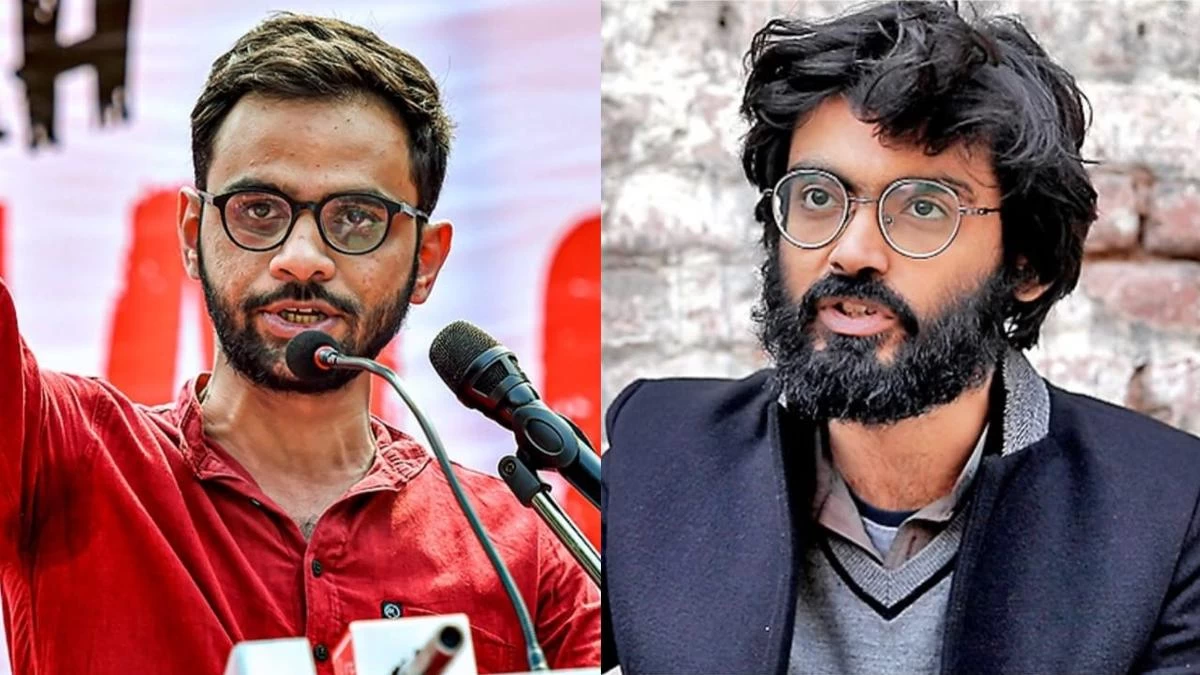
The Supreme Court on Monday refused to grant bail to student activists Sharjeel Imam and Umar Khalid, citing the gravity of allegations against them in the alleged conspiracy behind the February 2020 Delhi riots.
A Bench comprising Justices Aravind Kumar and N V Anjaria held that the two stood “on a qualitatively different footing” from other accused in the case and could not be granted bail merely on the ground of prolonged incarceration.
Imam and Khalid had challenged a Delhi High Court order denying them bail under the stringent Unlawful Activities (Prevention) Act (UAPA). Both have been in custody for several years in connection with the alleged larger conspiracy linked to the northeast Delhi violence.
At the same time, the top court granted bail to five other accused, Gulfisha Fatima, Meeran Haider, Shifa Ur Rehman, Mohd Saleem Khan, and Shadab Ahmad, while making it clear that the allegations against them had not diminished in seriousness. The Bench imposed 12 stringent conditions for their release and warned that any violation would result in cancellation of bail.
“The record discloses that all the appellants do not stand on equal footing as regards culpability. The hierarchy of participation requires the court to assess each application independently,” the court said, as quoted by Bar and Bench.
The judges clarified that bail proceedings are not meant to examine the defence in detail. “Bail is not a forum for evaluating defences. Judicial restraint is not an abdication of duty. The correct application requires the court to undertake a structured enquiry,” the order said.
The court also underlined the scope of Section 15 of the UAPA, which defines a “terrorist act”. It noted that the provision extends beyond physical violence and destruction to include acts that disrupt essential services or threaten the economic security of the country.
Explaining the distinction drawn between the accused, the Bench said: “Each application under the UAPA has to be examined independently, as the degree of participation and culpability differs. Umar Khalid and Sharjeel Imam stand on a qualitatively different footing as compared to other accused.”
The court further observed that Imam and Khalid could not claim the benefit of delay in trial to seek bail, even while directing that the trial be concluded expeditiously. It asked the trial court to ensure that protected witnesses are examined without delay.
The Delhi Police has consistently opposed bail to all accused, arguing that the 2020 violence was an “orchestrated, pre-planned and well-designed” conspiracy aimed at destabilising the country. Investigators have alleged that the riots were timed to coincide with the visit of then US President Donald Trump to India, to draw international attention to protests against the Citizenship Amendment Act (CAA).
The riots, which broke out on February 24, 2020 amid protests against the CAA and the proposed National Register of Citizens (NRC), left more than 50 people dead, most of them Muslims, and over 700 injured.
Around 20 people, including Imam, Khalid and former Aam Aadmi Party councillor Tahir Hussain, were chargesheeted for their alleged role in the larger conspiracy.