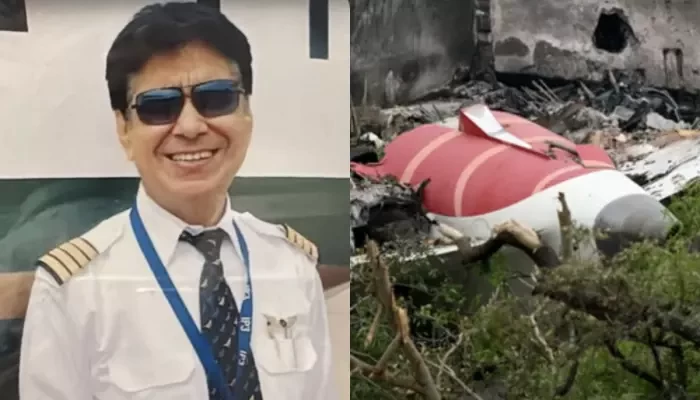
In a poignant courtroom exchange, the Supreme Court of India on Friday emphatically stated that the pilot of the ill-fated Air India flight that crashed in Ahmedabad in June cannot be held responsible for the tragedy that claimed 260 lives. Addressing a petition filed by the 91-year-old father of the deceased captain, the bench urged him to set aside unfounded guilt, emphasising that the preliminary investigation report contains no insinuation of fault on the pilot's part.
The crash occurred on June 12, 2025, when Air India Flight AI171, a Boeing 787-8 Dreamliner bound for London, plummeted moments after takeoff from Sardar Vallabhbhai Patel International Airport. The aircraft, carrying 229 passengers and 12 crew members, veered off course and collided with a nearby medical college hostel, killing all but one passenger on board and 19 people on the ground. Captain Sumeet Sabharwal, the pilot-in-command with over 30 years of unblemished service and more than 15,000 flying hours, perished along with First Officer Clive Kunder, who was at the controls during takeoff.
Pushkar Raj Sabharwal, the captain's father, filed the petition alongside the Federation of Indian Pilots, seeking a court-monitored independent judicial inquiry into the accident. The plea contends that the ongoing probe by the Aircraft Accident Investigation Bureau (AAIB) is biased, incomplete, and dominated by government officials, violating international aviation standards under ICAO Annex 13. It highlights technical anomalies in the July preliminary report - such as the unexplained cutoff of fuel supply to both engines, simultaneous electrical failures, and deployment of the Ram Air Turbine - while decrying media leaks that fuelled a narrative of pilot error.
A two-judge bench comprising Justices Surya Kant and Joymallya Bagchi heard the matter and issued notices to the Centre, Directorate General of Civil Aviation (DGCA), and AAIB, listing it for further hearing on November 10 alongside a similar public interest litigation.
Justice Surya Kant, speaking directly to the elderly petitioner, offered solace amid the grief. "It’s extremely unfortunate that this crash took place, but you should not carry this burden that your son is being blamed," he said. "Nobody can blame him for anything… No one in India believes it was the pilot's fault… It was an accident. There is no insinuation against him even in the preliminary report."
The judge elaborated on the report's findings, noting the cockpit voice recorder captured confusion but no admission of error. "One pilot asked whether the fuel was cut off by the other; the other said no. There's no suggestion of fault in that report," Justice Kant observed, with Justice Bagchi concurring: "There’s no suggestion of fault in that report."
The bench also rebuked sensational foreign media coverage, particularly a Wall Street Journal article implying pilot negligence based on anonymous sources. "We are not bothered by foreign reports. Your remedy should then be before a foreign court… That is nasty reporting," Justice Kant remarked, expressing concern over citations of Indian government officials in such pieces.
Pushkar Raj, represented by advocate Gopal Shankaranarayan, argued for a fresh probe by a committee led by a retired Supreme Court judge and independent experts to ensure transparency and address potential Boeing 787 design flaws, citing global incidents. The petition also invoked the family's right to dignity under Article 21, alleging violations from selective CVR leaks that smeared the captain's legacy.
This is the second such plea before the apex court; in September, it had termed pilot-blaming "irresponsible" based on the "very clean" preliminary findings. Meanwhile, families of four victims have sued Boeing and Honeywell in the US, alleging a defective fuel switch. Air India's CEO Campbell Wilson recently affirmed the airline's commitment to introspection, stating no operational faults were found but improvements to continue.