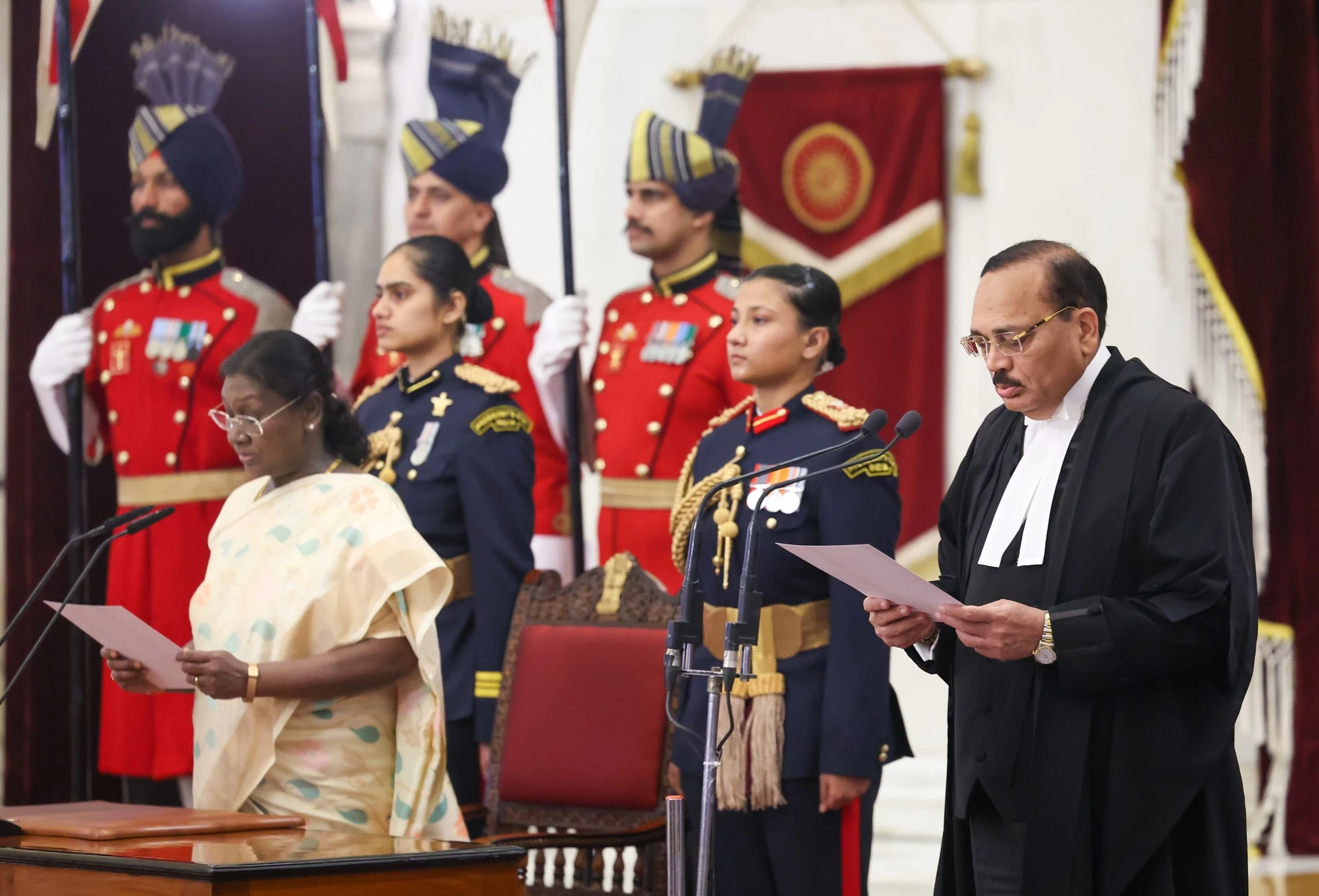
Justice Suryakant was sworn in as the 53rd Chief Justice of India (CJI) on Monday, becoming the first person from Haryana to hold the country’s top judicial post. President Droupadi Murmu administered the oath at a ceremony held at Rashtrapati Bhavan, attended by Prime Minister Narendra Modi and several Union ministers. His tenure will run for 15 months, until February 9, 2027.
Born on February 10, 1962, in Hisar, Justice Suryakant comes from a middle-class family. He completed his law degree from Maharshi Dayanand University in 1984 and began his legal career at the Punjab and Haryana High Court. In 2000, he became the youngest Advocate General of Haryana and was designated a senior advocate the following year.
He was appointed a judge of the Punjab and Haryana High Court in January 2004 and later served as the Chief Justice of the Himachal Pradesh High Court. On May 24, 2019, he was elevated to the Supreme Court.
During his time at the apex court, Justice Suryakant was part of several significant benches. Notably, he was on the bench that heard challenges to the Centre’s 2019 decision to revoke Jammu & Kashmir’s special status under Article 370. The Supreme Court upheld the government’s move and directed the conduct of assembly elections in the region.
He was also part of the bench that paused the registration of new cases under the colonial-era sedition law, and played a significant role in rulings that examined the powers exercised by governors and the President over state legislation.
Justice Suryakant upheld the One Rank One Pension (OROP) scheme for defence personnel, terming it constitutionally valid, and continues to hear petitions filed by women officers in the armed forces seeking equal opportunities in permanent commission.
He was a member of the seven-judge bench that overturned the 1967 Aligarh Muslim University ruling, paving the way for a fresh examination of the university’s claim to minority status.
Justice Suryakant was also part of the bench that handled the Pegasus spyware case, which appointed an independent panel of cyber experts to investigate allegations of unlawful surveillance. During the hearings, he famously observed that the state cannot be granted a “free pass under the guise of national security.”
In 2024, he directed that one-third of all positions in bar associations, including the Supreme Court Bar Association, be reserved for women.