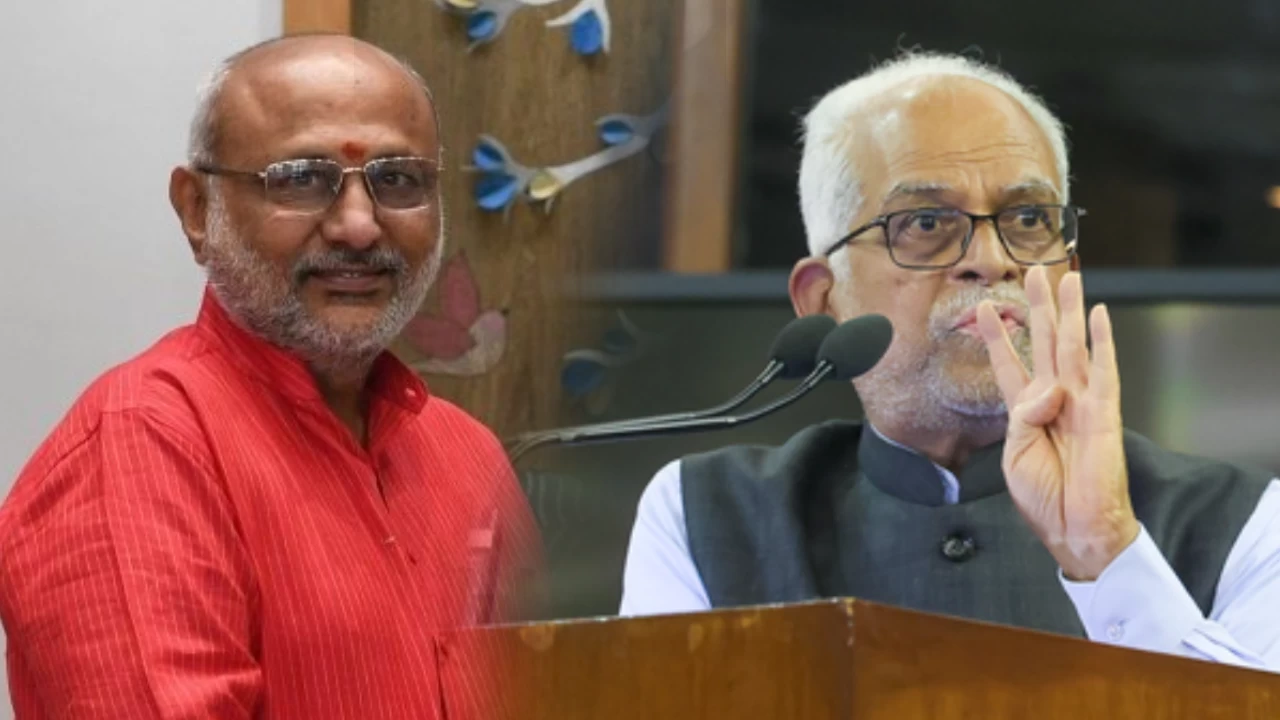
India is set to elect its new Vice President on September 9, 2025, following the resignation of Jagdeep Dhankhar in July due to health concerns. The election pits the National Democratic Alliance (NDA) candidate, C.P. Radhakrishnan, against the INDIA bloc’s nominee, B. Sudershan Reddy, in a contest shaped by parliamentary arithmetic and strategic abstentions by key regional parties.
The Numbers Game
The Vice Presidential election is decided by an electoral college comprising members of both houses of Parliament - Lok Sabha and Rajya Sabha, including nominated members. With a total of 788 eligible MPs, minus seven vacancies (including the late Shibu Soren), the current electoral college stands at 781 MPs. A simple majority, approximately 391 votes, is required to win.
NDA’s Strength
The NDA, led by the Bharatiya Janata Party (BJP), holds a commanding position with approximately 422 MPs:
Lok Sabha: 293 MPs
Rajya Sabha: 129 MPs
This number is bolstered by the support of the YSR Congress Party (YSRCP), which has 11 MPs (4 in Lok Sabha, 7 in Rajya Sabha), and other smaller allies, potentially pushing the NDA’s tally to 436 votes. The NDA’s numerical advantage makes its candidate, C.P. Radhakrishnan, the current Governor of Maharashtra, the frontrunner. However, the secret ballot system raises the possibility of cross-voting, which could slightly alter the final count.
INDIA Bloc’s Position
The opposition INDIA bloc, led by the Congress, has fielded B. Sudershan Reddy, a former Supreme Court judge known for his ruling against the Salwa Judum initiative. The bloc commands around 324 MPs, significantly less than the NDA. Despite unified support from parties like the Trinamool Congress (TMC), Dravida Munnetra Kazhagam (DMK), and Aam Aadmi Party (AAP), the absence of additional regional support limits their chances. The INDIA bloc is banking on potential cross-voting and the appeal of Reddy’s judicial credentials to narrow the gap.
Impact of BJD and BRS Abstentions
Two major regional parties, the Biju Janata Dal (BJD) and Bharat Rashtra Samithi (BRS), have announced they will abstain from voting, significantly affecting the electoral dynamics:
BJD: Led by Naveen Patnaik, the BJD has 7 Rajya Sabha MPs. The party’s decision to abstain aligns with its policy of maintaining “equal distance” from both the NDA and INDIA bloc, “prioritising Odisha’s regional interests”.
BRS: With 4 Rajya Sabha MPs, the BRS, under K. Chandrashekar Rao, is abstaining to protest the severe urea shortage in Telangana, which has led to farmer unrest. BRS leader K.T. Rama Rao noted that the party would have preferred a NOTA option if available.
The abstention of these 11 MPs (7 from BJD, 4 from BRS) reduces the effective electoral college to 770 voters. While this does not drastically alter the majority threshold (now around 386 votes), it disproportionately benefits the NDA. The INDIA bloc loses potential votes that could have been courted, while the NDA’s existing majority remains intact. Critics, including Congress leaders, argue that abstaining indirectly favours the NDA, as it reduces the opposition’s ability to challenge the ruling coalition’s dominance.
The Election Process
The Vice Presidential election, governed by Article 68 of the Indian Constitution, is conducted by the Election Commission of India, with Sabha Secretary General P.C. Mody serving as the Returning Officer. Here’s how it works: The election will take place on from 10 AM to 5 PM in Room No. F-101, Vasudha, Parliament House. MPs cast their votes via a secret ballot, ensuring no party whip can enforce voting discipline. Vote counting begins at 6 PM on the same day, with results expected by late evening. The secret ballot system introduces an element of unpredictability, as MPs are not bound by party lines, potentially leading to cross-voting.
The 2025 Vice Presidential election is more than a procedural formality; it’s a test of political strength ahead of future electoral battles, including the 2027 Presidential election. The NDA’s numerical superiority, reinforced by YSRCP’s support and the absence of BJD and BRS, positions Radhakrishnan for a likely victory. However, the INDIA bloc’s choice of Reddy, a non-partisan judicial figure, aims to frame the contest as a defence of constitutional values against political dominance.