The Centre has invoked the Essential Services Maintenance Act (ESMA) to ensure that natural gas supply to key sectors remains uninterrupted as tensions in West Asia continue to unsettle global energy markets.
The decision comes at a time when the conflict involving Iran, Israel and the United States has raised concerns about possible disruptions in fuel supplies worldwide.
According to officials, the government has issued an order giving priority to four key sectors in the allocation of natural gas to ensure that essential services and industries continue to function even if supplies tighten.
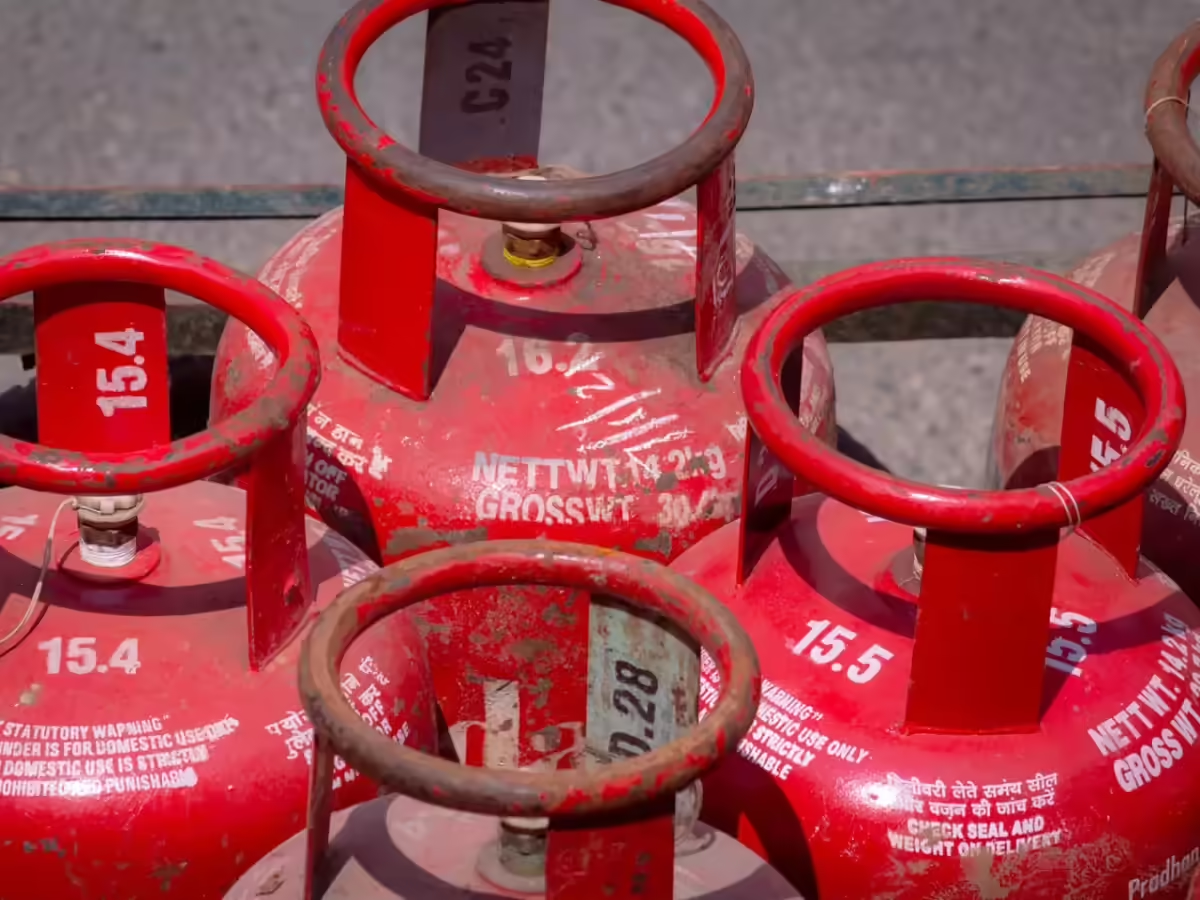
The first priority will be given to sectors that directly affect daily life. This includes piped natural gas (PNG) supplied to households, compressed natural gas (CNG) used in vehicles, LPG production, and fuel required for operating pipeline compressors and other essential pipeline systems.
The fertiliser sector has been placed in the second priority category due to its importance for agriculture. Fertiliser plants will be supplied up to 70% of their average gas consumption over the past six months, depending on availability. The government has made it clear that the gas provided must be used only for fertiliser production.
To ensure compliance, companies will have to submit a certificate through the Ministry of Fertilisers to the Petroleum Planning and Analysis Cell (PPAC) confirming that the gas is not being diverted for other purposes.
Under the third priority category, gas marketing companies have been asked to maintain supplies to industries such as tea processing units, manufacturing plants and other industrial consumers connected to the national gas grid.
These industries are expected to receive around 80% of their average gas consumption from the previous six months, depending on availability.
The fourth priority sector covers industrial and commercial consumers connected through City Gas Distribution (CGD) networks. They, too, will receive around 80% of their past six-month average gas consumption, subject to operational conditions.
To implement the order, the government has asked Gas Authority of India Limited (GAIL) to work with the Petroleum Planning and Analysis Cell to manage the redistribution and supply of natural gas across sectors.
A pooled pricing system will also be introduced for gas that is diverted from non-priority sectors to priority sectors. Companies receiving this gas will have to accept the pooled price and give an undertaking that they will not challenge the arrangement legally. They will also be prohibited from reselling the diverted supply.
The directive applies to the entire natural gas supply chain, including companies such as ONGC, Reliance Industries Limited, Oil India Limited, Vedanta, GAIL, LNG terminal operators, pipeline operators and city gas distribution companies.
Meanwhile, the recent rise in LPG prices has begun to affect the hospitality sector, particularly in cities such as Mumbai and Bengaluru, where some restaurants and small eateries say they are facing difficulty in getting commercial LPG cylinders.
Industry sources say the situation is linked to global supply disruptions caused by the ongoing tensions in West Asia, which have pushed up international LPG prices.
However, in Maharashtra and Karnataka, several small restaurants and food establishments are already dealing with a shortage of commercial LPG cylinders following the latest price increase.