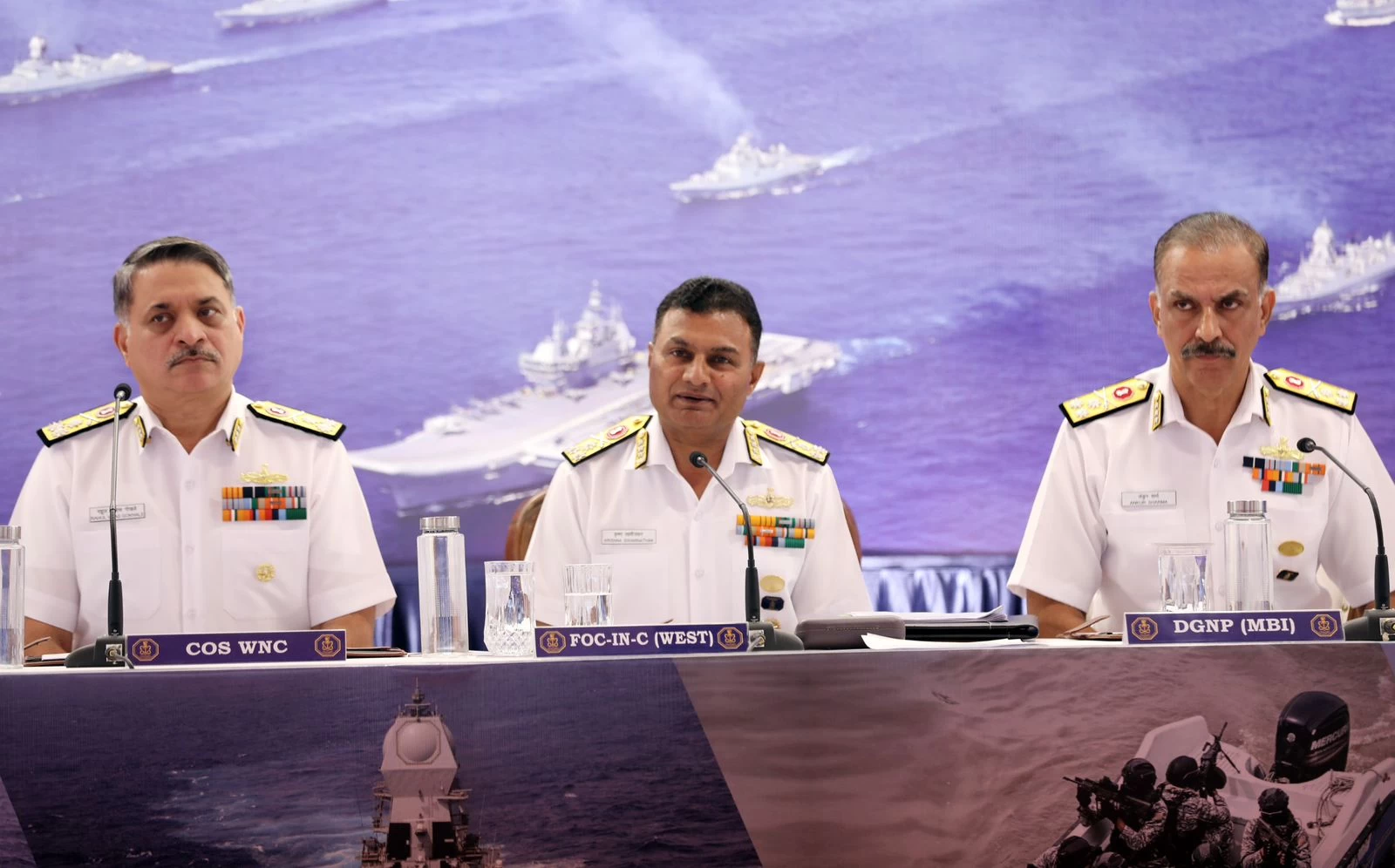
The Western Naval Command on Tuesday disclosed that India came “very close” to launching strikes on Pakistan during Operation Sindoor, with frontline naval assets positioned for combat off the Makran coast. The rare revelation came during the Command’s first major media interaction since the operation, held at Navy Nagar, Mumbai, ahead of Navy Day on 4 December. The briefing was led by Flag Officer Commanding-in-Chief (West), Vice Admiral Krishna Swaminathan. The Western Command oversees India’s maritime areas spanning Maharashtra, Gujarat and Goa.
Recounting the heightened tensions of the period, Vice Admiral Swaminathan said, “We mobilised more than 30 ships and submarines at short notice. Once the adversary realised the Navy was moving, they declared a ceasefire.” He added, “Our frontline ships were poised for combat off the Makran coast, under the umbrella of the Vikrant Carrier Battle Group.”
The Vice Admiral emphasised that Operation Sindoor remains in force. “The Navy is prepared to undertake any mission required to safeguard India’s maritime interests,” he said.
Responding to reports of a Turkish Navy vessel operating in Pakistani waters at the same time, he said India had long anticipated strategic cooperation between Pakistan, China and Turkey. “We always expected some form of collusion. It was only left for us to see how that collusion manifested in hardware transfer, even while the operation was on,” he noted.
He added that the Turkish ship’s visit to Pakistan had been pre-planned.
“The fact that Turkey colluded with Pakistan was something we had expected, and we saw that unfold.”
Reflecting on broader lessons from the operation, he said the most significant takeaway was the “very, very good political-military synergy” at the highest levels of decision-making. Coordination among the three services had also been strong, with each aware of the other’s operational plans and movements.
He highlighted the growing push towards jointness, citing Exercise Trishul, conducted with the Southern Army Command and the South Western Air Command. The exercise involved over 35,000 troops, more than 500 Army vehicles including tanks and BMPs, over 25 naval platforms, and more than 50 Air Force aircraft. Units from the Armed Forces Special Operations Division, Defence Space Agency, Defence Cyber Agency, Coast Guard and BSF also participated.
Vice Admiral Swaminathan warned of an increase in non-traditional maritime challenges, including terrorism, piracy, illegal fishing and trafficking. He said the Navy had carried out 41 anti-piracy operations in the past two years, rescuing more than 180 people, foiling eight pirate attacks, and arresting 62 pirates, while ensuring safe passage for over 125 million metric tonnes of cargo.
On narcotics, he said the Navy had intensified interdiction operations, seizing nearly 7,000 kg of drugs worth around ₹40,000 crore since February 2024. INS Tarkash alone accounted for 2,500 kg of the contraband.
In addition, the Vice Admiral underscored the Navy’s progress in indigenisation. Over 40 vessels have been delivered by Indian shipyards in the past decade, 11 commissioned this year, and 51 more currently under construction.
Indigenous content in current warship projects now stands at 90% in the float segment, 60% in move, and 50% in fight. Of the 519 items listed under the Defence Ministry’s Positive Indigenisation Lists, the Navy is pursuing 218, with approvals granted for 111, and contracts finalised for 60.