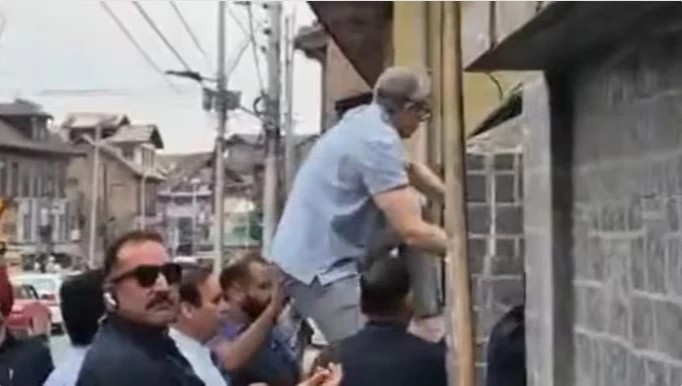
Jammu and Kashmir Chief Minister Omar Abdullah on Monday managed to reach the Mazar-e-Shuhada (Martyrs’ Graveyard) in Srinagar, bypassing security barricades and jumping over a boundary wall to pay homage to those killed on July 13, 1931, during protests against Dogra rule. Abdullah stated that he was subjected to “physical grappling” by the police as he and his cabinet of ministers reached the memorial site.
Chaotic unfolded near the graveyard in the Old City’s Nowhatta area as security forces attempted to stop Abdullah. Despite being barred from visiting the memorial on Sunday, the official day of observance, Abdullah made a surprise visit on Monday morning.
Sharing a video of the incident on social media platform X, Abdullah wrote, "This is the physical grappling I was subjected to but I am made of sterner stuff and was not to be stopped." The former chief minister strongly criticised the security forces for preventing him from offering fatiha (prayers) at the site. "I was doing nothing unlawful or illegal. In fact, these 'protectors of the law' need to explain under what law they were trying to stop us from offering fatiha," he added.
Abdullah explained that on Sunday, July 13, traditionally observed as Martyrs’ Day in Kashmir, he was confined to his residence and not allowed to visit the graveyard.
"It is unfortunate that by the orders of those who claim their responsibility is to maintain law and order, we were not allowed to read the fatiha here yesterday. People were kept confined to their homes," he told reporters after offering prayers.
He said that despite informing the control room about his intentions on Sunday, a bunker was placed outside his gate and remained there until late at night. "Today I did not tell them at all. Without telling them, I sat into the car and drove here," he revealed.
Even on Monday, he claimed, security forces attempted to stop him and manhandled his ministers. "Look at their shamelessness. Even today, they tried to stop us. We parked the car at Nowhatta Chowk. They put a bunker in front of us and tried to manhandle us," he said. "These policemen in uniform sometimes forget the law. I want to ask them, under which law did they try to stop us today? The restrictions were for yesterday."
Targeting the administration under Lieutenant Governor Manoj Sinha, Abdullah said, "They say this is a free country, but sometimes they think we are their slaves. We are not anyone’s slaves. If we are slaves, we are the people's slaves." He alleged that security personnel also tried to tear their flags and block access to the graveyard. "They tried to stop us, to tear apart our flags, but their attempts failed. We came and read the fatiha," he said.
The Jammu and Kashmir Chief Minister compared the July 13 massacre to the Jallianwala Bagh tragedy. "The 13th July massacre is our Jallianwala Bagh. The people who laid down their lives did so against the British. Kashmir was being ruled under British Paramountcy," he said.
"What a shame that true heroes who fought against British rule in all its forms are today projected as villains only because they were Muslims."
Martyrs’ Day, observed annually on July 13 in Jammu and Kashmir, marks a turning point in the region’s political history. On this day in 1931, a group of Kashmiris gathered outside Srinagar Jail in support of Abdul Qadeer, who was imprisoned for inciting resistance against Maharaja Hari Singh's Dogra regime.
As the crowd protested, Dogra forces opened fire, killing 22 demonstrators. This event triggered widespread unrest and is seen as the beginning of political consciousness in Kashmir. It ultimately led to reforms, including the region’s first assembly elections, though the Maharaja continued to hold significant power.
Until recent years, Martyrs’ Day was officially commemorated with police salutes and floral tributes. Political leaders visited the graveyard to honour the slain and participated in public gatherings.
However, after the revocation of Jammu and Kashmir’s special status in 2019 and its conversion into two Union Territories, the local administration has barred all official functions at the site. Since 2020, July 13 and Sheikh Abdullah’s birth anniversary on December 5 have been removed from the list of public holidays. In contrast, Maharaja Hari Singh’s birthday has been declared a public holiday.