Tensions between Thailand and Cambodia reignited on Sunday night after Thailand’s military launched airstrikes on Cambodian territory after Cambodian soldier’s allegedly “fire small arms and curved weapons leading to death of Thai soldier. This move dropped a serious blow to the fragile ceasefire agreement brokered by US President Donald Trump in October.
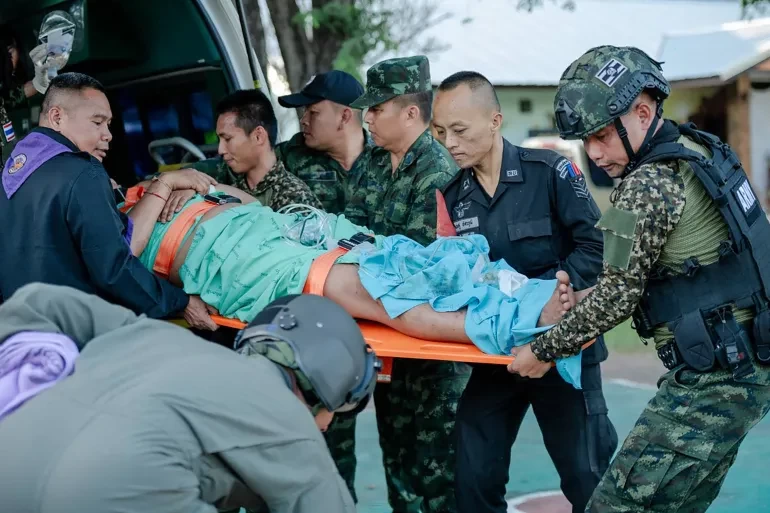
The strikes, launched early Monday along disputed border areas, followed what the Thai army described as “supporting fire” from Cambodian forces that killed at least one Thai soldier and wounded several other.
“On the morning of December 8, 2025, around 05:04 AM, the Thai military forces launched an attack on the Cambodian forces in An Ses area, Preah Vihear province. Subsequently, they continued firing multiple shots with tanks at Tamone Thom temple, 5 Makara in the vicinity of Preah Vihear temple and Chomka Chek area. It should be noted that this attack occurred after the Thai forces engaged in numerous provocative actions for many days, especially the incident yesterday at Prorlean Thmar area, with the objective of instigating confrontations,” Spokeswoman of the Ministry of National Defence Lieutenant General Maly Socheata said in a statement.
Meanwhile, Thailand PM Anutin Charnvirakul held an emergency meeting with the country’s National Security Council promising to “respond with military operations in all instances corresponding with the situation,” after calling the airstike on its neighbor “retaliatory,” Thai PBS World reported.
In a statement Thailand Military spokesperson Major General Winthai Suvari informed media that Bangkok deployed aircrafts “to suppress Cambodian attacks.” According to Thai Defence Ministry, Cambodian forces opened fire and wounded two Thai soldiers, prompting Thai units to respond. The ensuing exchange of gunfire continued for approximately twenty minutes.
Clashes flared again just one day after a separate short episode of combat in the Phu Pha Lek–Phlan Hin Paet Kon sector of Thailand’s Sisaket province, with each side attributing responsibility to the other.
Thailand deployed air power targeting what it called Cambodian military positions, marking the first major aerial operation since the July conflict that displaced hundreds of thousands.
Cambodia strongly condemned the attack calling it “inhumane and brutal acts.” It added that such action causes “grave violation” of the the Joint Declaration between Cambodia and Thailand, signed by Prime Ministers of both countries on October 26, 2025, with the auspicious witness of the U.S. President Donald J. Trump and Malaysian Prime Minister, H.E. Anwar Ibrahim, in his capacity as the ASEAN rotating Chair.
The aforementioned ceasefire, formalized in late October at a high-profile ceremony in Kuala Lumpur witnessed by Trump and regional leaders was meant to halt the deadly border fighting that erupted earlier this year in July. Atleast 48 people were killed during the hostilities and over 3,00,000 were displaced.
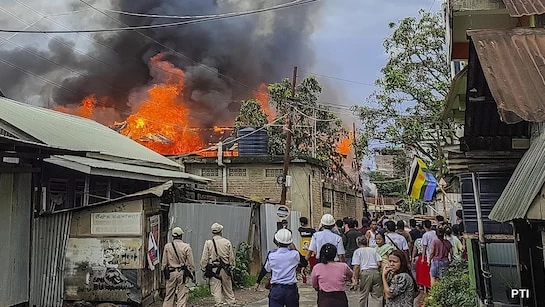
With Monday's airstrikes, the peace pact now seems in tatters. The escalation has triggered mass evacuations on both sides of the border, with over 35,000 civilians fleeing to temporary shelters, fearing further violence. International observers and regional leaders are now calling for urgent diplomacy to prevent a full-blown war between the two neighbours.
What is the Cambodia–Thailand conflict?
The Cambodia–Thailand conflict refers to a long-standing territorial dispute centered primarily around segments of their shared border. While the relationship between the two nations has included periods of cooperation, the boundary has remained a source of recurring political friction, military skirmishes, and nationalist tensions. The most notable flashpoints are areas where historical claims overlap and where colonial-era maps left ambiguity in the demarcation line.
Much of the conflict stems from differing interpretations of maps produced during the French colonial administration of Indochina. These maps placed certain temple complexes and surrounding land, most famously the Preah Vihear Temple, inside modern-day Cambodia, even though Thailand historically asserted cultural and administrative connections to the region. In 1962, the International Court of Justice (ICJ) ruled that the temple belonged to Cambodia, but the judgment did not clearly resolve the sovereignty of adjacent land, leaving room for continued disagreement.
Tensions intensified in the late 2000s and early 2010s, when both nations increased military presence near disputed border zones. Occasional exchanges of gunfire, artillery shelling, and infantry clashes resulted in fatalities on both sides and displaced thousands of civilians. These confrontations were often tied to domestic political pressures, as leaders in both countries faced nationalist demands to assert territorial claims more forcefully.
Both governments sought recourse through regional diplomacy and international legal mechanisms. In 2013, the ICJ issued a clarification reinforcing that the area surrounding the Preah Vihear Temple should also be considered Cambodian territory. Despite the ruling, practical border demarcation has remained incomplete, and implementation has been subject to logistical, political, and military complications.
Beyond political and military considerations, the conflict has carried significant humanitarian and economic consequences. Border communities frequently experience evacuations, disrupted trade, and damage to local infrastructure during periods of escalation. These interruptions place stress on bilateral economic ties, which otherwise depend heavily on cross-border commerce and labor movement.
In recent years, both nations have intermittently attempted to stabilize relations through joint border committees, military-to-military communication channels, and diplomatic forums such as ASEAN. However, periodic flare-ups continue to demonstrate the fragility of the peace, often triggered by localized incidents, nationalist rhetoric, or shifting political landscapes in either country.