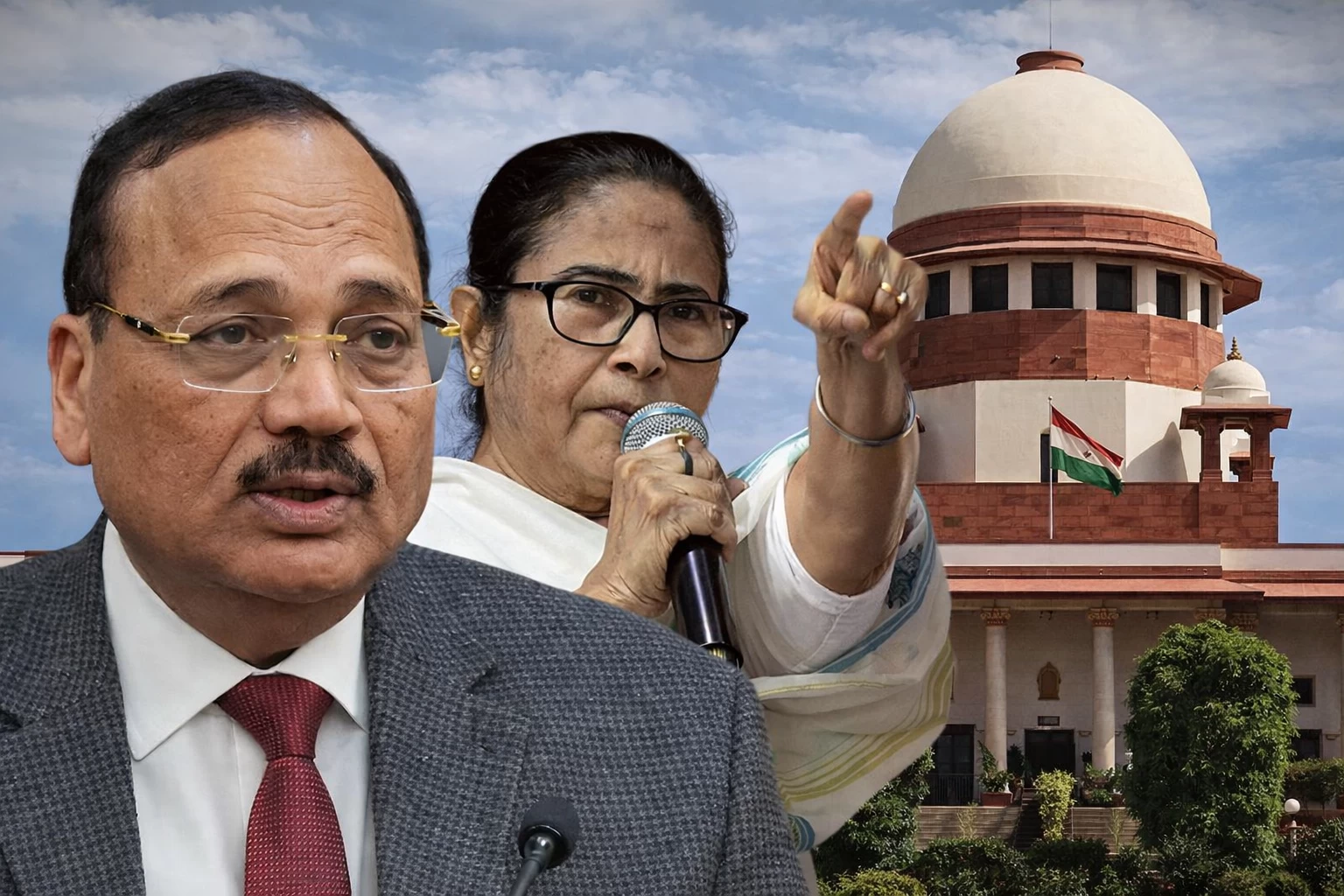
The Supreme Court of India on Tuesday modified its previous order and issued fresh directions to speed up the verification of disputed entries in West Bengal’s voter list revision, permitting the Chief Justice of the Calcutta High Court to draw more judicial officers - including civil judges and even seek assistance from neighbouring states Odisha and Jharkhand, if the need arises. The directions came during a hearing on petitions concerning the Special Intensive Revision (SIR) of electoral rolls in West Bengal, where the court was informed that the scale of verification required was far greater than initially anticipated.
“May Take 80 Days”
At the start of the hearing, Chief Justice Surya Kant referred to a status report from the Calcutta High Court and highlighted the magnitude of the work ahead.
“Going by the calculation… even if one officer decides 50 objections in a day, it will take around 80 days,” the Chief Justice observed in court. The bench noted that approximately 80 lakh cases involving ‘logical discrepancy’ or unmapped voters required scrutiny, and around 50 lakh claims and objections have already been assigned to judicial officers.
In its order, the court recorded: “We are in receipt of a self-speaking letter dated 22.02.2026 from the Hon’ble Chief Justice of the Calcutta High Court highlighting the exercise to be undertaken in verification of approximately 80 lakh cases of LD/unmapped voters.” The letter, the court said, indicated that 250 judicial officers of the rank of District Judge or Additional District Judge were already engaged in the process. However, the bench noted that even if each officer disposed of around 250 cases daily, “the exercise could still extend for nearly 80 days”.
In an unusual intervention, the Supreme Court on Friday ordered the deployment of judicial officers to handle adjudication work in West Bengal’s SIR related pending cases of scrutiny, citing a breakdown of trust between the State government and the Election Commission of India (ECI). CJI Surya Kant had then lamented over an “unfortunate blame game” and “allegations and counter-allegations,” which has led to a “trust deficit between two Constitutional bodies, namely the democratically elected State Government and the Election Commission of India.” The Supreme Court had urged the Calcutta High Court to assign judicial officers so that cases could be disposed.
Supreme Court Permits Civil Judges to Assist
But realising the mammoth work load and time constraints, the Supreme court expanded the pool of judicial officers who could be deployed for the exercise.
In its directions, the bench said: “In addition to judicial officers already assigned the task, the Chief Justice of the High Court will be entitled to draw officers from the rank of civil judges (senior and junior division) having experience of not less than three years, so that the work can be taken up on a war footing.” This marks a significant widening of the judicial workforce overseeing voter verification.
The court also allowed the Calcutta High Court to seek help from neighbouring states if further manpower is required. The order states: “If the Chief Justice is of the opinion that further human resources will be required… he is at liberty to approach the Chief Justices of the High Courts of Jharkhand and Orissa to provide serving or former judicial officers of similar rank.” Expenses such as travel, boarding and honorarium of such officers will be borne by the Election Commission of India, the court added.
During the hearing, concerns were raised about language barriers if judges from other states were brought in, particularly by Advocate Kalyan Banerjee who also happens to be Trinamool Congress MP . The Chief Justice responded that neighbouring states had historical and geographical proximity to Bengal and would likely have familiarity with the region - the reason why Odisha and Jharkhand were specifically mentioned and not other states like Haryana or Uttar Pradesh.
Documents That Can Be Considered
The bench also clarified the scope of the verification exercise. According to the order, verification should be conducted with reference to earlier Supreme Court directions permitting Aadhaar as proof of identity, and subsequent orders allowing additional documents such as certificates and admit cards. The court directed that documents submitted on or before 14 February be taken into consideration. It further stated that it would be the responsibility of the Election Registration Officers (ERO/AERO) to satisfy the presiding judicial officer regarding the validity of documents. Election Commission of India in a previous notification had disallowed acceptance of class X admit cards issued by Bengal Government’s Madhyamik board of secondary education - as proof of date of birth. That decision was slammed by Mamata Banerjee government as discriminatory and bizarre because that document has standard acceptance even for passport verification.
The bench acknowledged the tight timeline for completion of the process, with the final electoral roll scheduled to be published on February 28. However, it clarified that if verification of the “LD/unmapped” category remains incomplete by then, the Election Commission may publish the final list and later issue supplementary lists
Invoking its constitutional powers, the court observed: “In exercise of Article 142 powers, voters in such supplementary list shall be deemed to have been part of the final list published on 28 February.” The court also emphasised that its focus was ensuring fairness in the process. Justice Joymalya Bagchi remarked during the hearing: “We are not concerned with voters coming forward now; we are concerned with fairness.”