.webp)
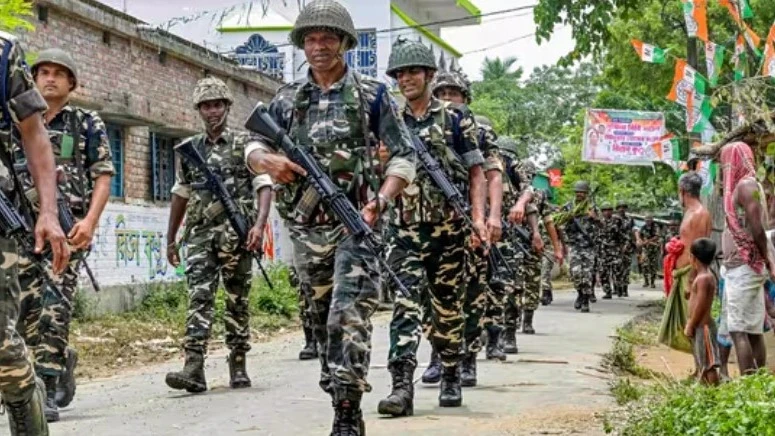
The Calcutta High Court has held that the ongoing Special Investigation Report (SIR) procedure cannot be cited as a ground to delay the handover of land already acquired for fencing along the Indo-Bangladesh Border, directing the West Bengal government to transfer possession of such land to the Border Security Force (BSF) by March 31, 2026. The court underscored that where land acquisition has been completed and compensation paid, procedural formalities cannot obstruct a matter directly linked to national security.
The direction was issued by a bench comprising Chief Justice Sujoy Paul and Justice Partha Sarathi Sen while hearing a public interest litigation filed by a former Deputy Chief of Army Staff. The petitioner argued that the fencing of the Indo-Bangladesh Border (IBB) is essential to safeguard the integrity and sovereignty of the country and that delays in handing over land were undermining this objective.
Taking note of the submissions, the bench observed that a substantial portion of land falling under the first category—where acquisition or purchase had already been completed and compensation received—had not been fully handed over to the BSF. “In view of admitted position of acquisition/purchase of lands in first category and acceptance of compensation for these pieces of land, we deem it proper to direct the State Government to hand over the aforesaid lands as per the fifth chart to the B.S.F. before 31st March, 2026,” the court ordered.
The court further clarified that the pendency of the SIR procedure could not be treated as an impediment to expediting the handover of land in nine border districts. It categorically stated that once acquisition is complete and compensation accepted, the obligation to hand over possession must follow without delay.
The PIL brought to light that large stretches of the Indo-Bangladesh border in West Bengal remain unfenced despite completion of land acquisition and disbursal of compensation. The petitioner placed on record data indicating a sharp rise in cross-border infiltration, narcotics smuggling, and seizures of fake currency, cattle, and gold, particularly in districts abutting the international border. It was submitted that fencing the IBB is a matter of national interest and critical to internal security.
It was also highlighted that in at least nine districts, compensation amounts had already been paid, yet the entire land required for fencing was not handed over to the BSF, preventing it from initiating and completing the fencing work. The Additional Solicitor General, appearing in the matter, submitted that to curb cross-border terrorism and infiltration, it was necessary for the court to issue directions to the state government to complete the exercise expeditiously.
In its findings, the court categorised the issue into three distinct classes. The first category pertains to lands already acquired or purchased, for which compensation has been received by the state government from the Centre, but only partial possession has been handed over to the BSF. The second category relates to lands where acquisition or purchase proceedings have commenced under the direct purchase policy but remain incomplete at various stages, including pending approval before the state government. The third category concerns lands where the acquisition or purchase process has not yet begun.
The bench noted that a sizeable number of land parcels fall within the first category and emphasised that these must be handed over to the BSF at the earliest. With regard to the second category, the court directed the state government to file an Action Taken Report before the next date of hearing, detailing the steps taken to complete the acquisition or purchase proceedings.
As far as the third category is concerned, the court observed that fresh acquisition would depend on the applicability of Section 40 of the Right to Fair Compensation and Transparency in Land Acquisition, Rehabilitation and Resettlement Act, 2013. It held that a decision on this aspect would be taken after hearing the parties on the applicability and feasibility of invoking the said provision.