The Centre on Friday opposed a plea seeking a reduction in the Goods and Services Tax (GST) on air purifiers, arguing before the Delhi High Court that tax rates cannot be altered through judicial intervention, even as the city continues to grapple with hazardous air quality.
Appearing for the Union government, Additional Solicitor General N Venkataraman told a Bench of Justice Vikas Mahajan and Justice Vinod Kumar that a request to slash GST on air purifiers from 18 per cent to 5 per cent was not legally sustainable. He said decisions on GST rates fall exclusively within the domain of the GST Council, which follows a structured process involving deliberation among stakeholders, licensing norms and regulatory mechanisms. “This cannot be scuttled through a writ petition,” the ASG submitted.
The government also argued that air purifiers cannot automatically be classified as medical devices, a categorisation that would attract a lower tax rate. Such a determination, it said, lies with the Ministry of Health, which has not been made a party to the case. “If this is allowed, it will open a Pandora’s box,” Venkataraman warned, adding, however, that the Centre had not yet taken a final view on the issue.
The submission came a day after the High Court adopted a sharply critical tone while hearing the matter. On Thursday, a division bench of Chief Justice D K Upadhyaya and Justice Tushar Rao Gedela told the government it had two choices: “Provide fresh air or reduce GST on air purifiers.” The court described tax relief as the “minimum” the state could do in the face of what it termed a public health emergency.
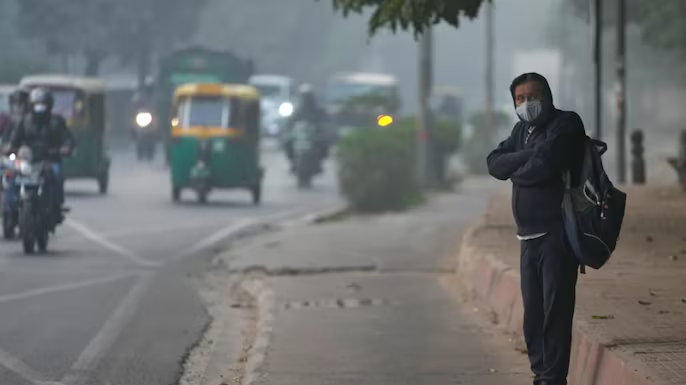
Flagging the severity of the pollution crisis in Delhi and neighbouring regions, the bench noted that air purifiers typically cost between ₹10,000 and ₹15,000, placing them beyond the reach of poorer households. It questioned why taxes could not be reduced to make the devices more affordable to vulnerable sections of society.
The petition was filed by advocate Kapil Madan, who told the court the plea was not adversarial in nature. He argued that even a plain reading of the relevant GST notifications, particularly Schedule I, which attracts a 5 per cent rate, suggested that air purifiers were being taxed under an incorrect category.
When the court asked why the GST Council could not take a call on the issue, the Centre responded that recommendations of a Parliamentary Standing Committee on the matter were still under consideration.
The debate has unfolded against the backdrop of alarming public health data. According to Global Burden of Disease estimates, hazardous air quality was linked to nearly 15 per cent of all deaths in Delhi in 2023, making it the city’s single largest health risk. Despite this, the Centre has maintained that there is “no conclusive evidence” directly linking air pollution to mortality, describing it as one among several contributing factors.