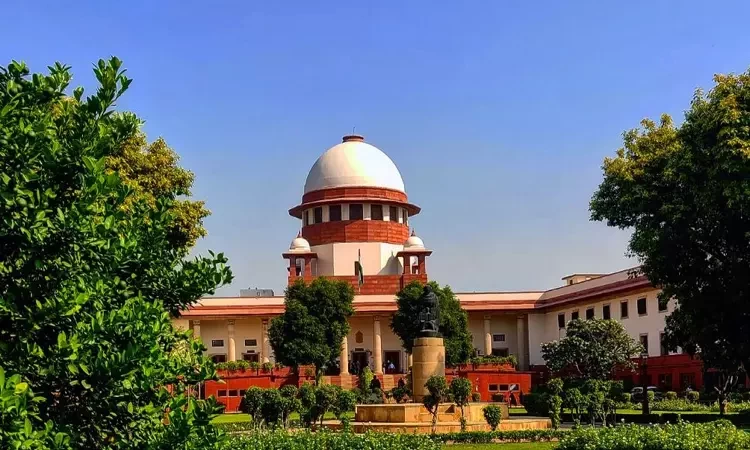
The Supreme Court on Thursday stayed the Bombay High Court’s acquittal of 12 men convicted in the 2006 Mumbai train blasts case. This comes after the Maharashtra government warned that the High Court’s findings could negatively affect ongoing cases under the Maharashtra Control of Organised Crime Act (MCOCA). However, the top court clarified that it would not halt the release of the 12 accused, who had already walked free earlier this week following their acquittal.
A bench comprising Justices M M Sundresh and N Kotiswar Singh issued notice to all 12 acquitted men, seeking their response to the state government’s appeal. The bench stated that the High Court’s decision “shall not be treated as a precedent” and formally stayed the effect of the judgment in terms of its legal standing. “We are inclined to hold that the impugned judgment shall not be treated as a precedent. Therefore, there will be a stay of the impugned judgment,” the bench said in a brief but significant order.
The Supreme Court was hearing a plea filed by the Maharashtra government, which challenged the 21 July ruling of the Bombay High Court. Appearing for the state, Solicitor General Tushar Mehta clarified that the government was not seeking to reverse the release of the acquitted individuals but was concerned about the broader implications of the High Court’s observations. “I am conscious of the matter of liberty. I am not seeking a stay on their release. But we want the judgment to be stayed because there are certain findings by the High Court which may affect other pending MCOCA trials. Thus, the impugned judgment needs to be stayed,” Mehta submitted to the court.
The Supreme Court accepted this reasoning and agreed that the High Court’s conclusions, if left unchecked, could set an unwelcome precedent for other cases under MCOCA.
A series of seven powerful bombs exploded within a span of just 11 minutes aboard Mumbai’s suburban trains on 11 July 2006. The blasts, triggered using improvised explosive devices hidden in pressure cookers, targeted first-class compartments during peak evening hours.
The attacks killed 188 people and left over 800 injured, making it one of the deadliest terror incidents in Indian history. The Maharashtra Anti-Terrorism Squad (ATS) launched an extensive investigation, arresting 13 men within four months. The ATS alleged that the plot was carried out by former members of the banned Students’ Islamic Movement of India (SIMI), aided by the Pakistan-based Lashkar-e-Taiba (LeT). Authorities also claimed that 12 Pakistani nationals had infiltrated India to help with logistics and training.
In 2015, a special court set up under MCOCA convicted 12 of the 13 accused. Five were sentenced to death while the rest received life imprisonment. One accused, schoolteacher Abdul Wahid Shaikh, who had refused to confess during the investigation, was acquitted. One of the original 13 died during the long-drawn appeals process in the High Court.
Earlier this week, the Bombay High Court overturned all 12 convictions, delivering a 400-page judgment that sharply criticised the prosecution. Justices Anil S Kilor and Shyam Chandak found that the state had “utterly failed to establish the offence beyond reasonable doubt.” They described the investigation as “riddled with procedural lapses, unreliable evidence, and grave violations of constitutional rights.”
The High Court ruled that the confessional statements used as the backbone of the prosecution’s case appeared to be “cut-copy-paste” documents. Many of these confessions were retracted during the trial, with accused persons alleging they had been extracted under coercion—a claim the court found plausible due to multiple procedural violations.
Importantly, the court noted that the accused were not informed of their right to consult with a lawyer before making any confessions, despite having legal representation on record. This was deemed a serious breach of fundamental rights.
The High Court also questioned the reliability of key eyewitnesses. These included two taxi drivers and several train passengers who claimed to have seen the accused planting the bombs. Their testimonies were recorded over 100 days after the blasts, and in some cases years later, during identification parades deemed legally improper. The parades themselves were conducted by unauthorised personnel.
In addition, the material evidence, RDX, pressure cookers, soldering irons, circuit boards, and maps, was ruled inadmissible. The court found that the chain of custody had been broken, and that forensic protocols were not properly followed. Items were allegedly not sealed before testing, raising doubts about their origin and authenticity.
Further scrutiny was directed at the invocation of MCOCA itself. The High Court found that the law had been applied improperly, with numerous lapses in the manner in which its provisions were triggered. In strong words, the court said the investigation led to a “deceptive closure” of the case and had likely let the real culprits go free, thereby damaging public confidence in the justice system.