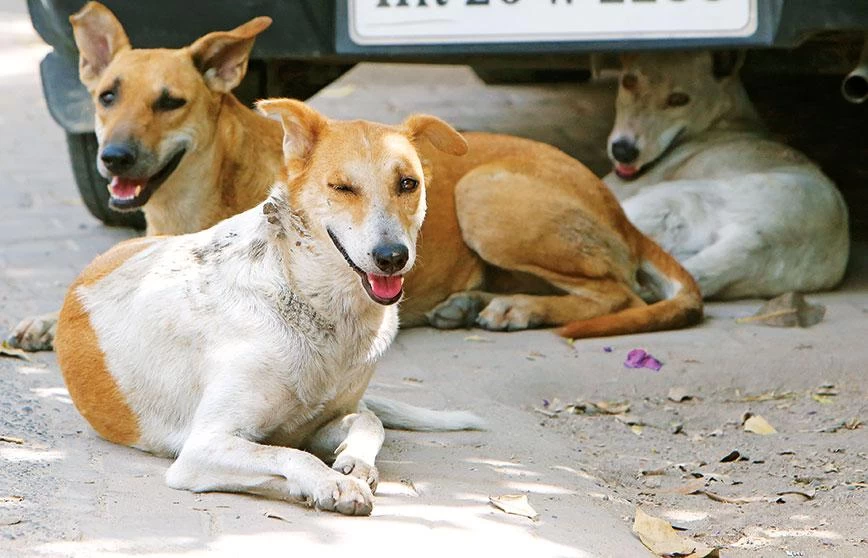
The Supreme Court on Friday revised its earlier directive mandating the permanent confinement of stray dogs across the Delhi-National Capital Region (NCR), allowing for their return to the streets post-sterilisation and vaccination. The ruling came as a significant modification to the Court’s earlier suo motu order dated 11 August 2025, which had ordered civic bodies to capture and shelter all stray dogs without the possibility of release.
A three-judge Bench comprising Justices Vikram Nath, Sandeep Mehta, and N.V. Anjaria stated that healthy stray dogs, once dewormed, vaccinated, and sterilised, shall be returned to their original areas of habitation. The Court clarified, however, that dogs infected with rabies or exhibiting aggressive behaviour must not be released and should instead be housed in separate shelters following necessary medical care.
“The earlier prohibition on release shall remain in abeyance. The dogs, once dewormed and vaccinated, shall be returned to the same area,” the Bench ruled.
The Supreme Court also instructed municipal authorities to create designated feeding zones in each municipal ward. These areas should be clearly marked with signage, and feeding stray dogs outside these zones is now prohibited. “Feeding of the stray dogs on the streets shall not be permitted under any condition,” the Bench stated, adding that anyone violating this order would face legal action.
To enforce compliance, municipal bodies have been directed to set up dedicated helplines for the public to report violations. The Court also warned that obstructing public servants from implementing the directive would invite legal consequences.
Expanding the scope of the matter nationwide, the Court impleaded all States and Union Territories and called for a uniform policy across India. Furthermore, it directed the transfer of all related cases pending in various High Courts to the Supreme Court.
Additionally, the Bench ordered all animal lovers and NGOs who had approached the Court to deposit Rs 25,000 and Rs 2 lakh respectively with the SC Registry within seven days. Failure to comply would bar them from participating further in the proceedings. “Those interested in adopting stray dogs may apply to the concerned municipal authority. It shall be the adopter’s responsibility to ensure the dog does not return to the streets,” the order said.
Municipal authorities have also been instructed to file compliance reports detailing available infrastructure in line with the Animal Birth Control (ABC) Rules.
Congress leader Rahul Gandhi hailed the revised order, calling it a forward-looking decision that balances public safety and animal welfare. “I welcome the Supreme Court’s revised directions on stray dogs, as it marks a progressive step toward balancing animal welfare and public safety. The approach is both compassionate and rooted in scientific reasoning,” Gandhi said.
BJP leader and animal rights activist Maneka Gandhi also welcomed the ruling, saying it reflects a scientific understanding of stray dog behaviour and public health. “I am very happy with this scientific judgement. Relocation and fear are the primary reasons dogs bite. There is no question of releasing dogs infected with rabies,” she said.
Soon after the ruling, animal lovers and activists gathered at Jantar Mantar broke into celebration, embracing one another and chanting slogans of relief and victory. “We were very anxious, but today’s decision gives us hope that kindness and science will go hand in hand,” said one activist. Many expressed their gratitude for what they saw as a balanced and humane solution to a complex issue.