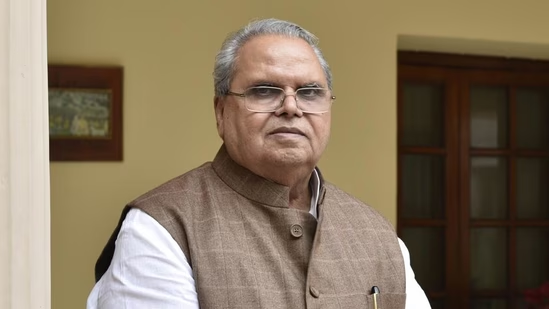
Satyapal Malik, the former Governor of Jammu and Kashmir, passed away on Tuesday at the age of 79 following a prolonged illness. He died at Delhi’s Ram Manohar Lohia Hospital at 1:10 PM, according to confirmation from his personal secretary, K.S. Rana.
Malik had been hospitalised since 11 May due to kidney-related complications and had been undergoing regular dialysis. The hospital authorities reported that despite ongoing treatment, his condition worsened in recent weeks. In early June, Malik had taken to social media to update the public on his health, describing his situation as “serious.” He had also mentioned that he had been admitted for over a month, receiving care for kidney issues.
A seasoned politician, Satyapal Malik was best known for his tenure as the last Governor of the erstwhile state of Jammu and Kashmir. He held the post from August 2018 to October 2019, a period marked by significant political change. It was during his governorship that Article 370 was abrogated on 5 August 2019, stripping Jammu and Kashmir of its special constitutional status. Today marks the sixth anniversary of that landmark decision.
Following his time in Jammu and Kashmir, Malik was appointed Governor of Goa and later served as the Governor of Meghalaya, a post he held until October 2022.
Born in Baghpat, western Uttar Pradesh, Malik began his political journey in the mid-1960s, inspired by the socialist ideals of Dr Ram Manohar Lohia. His early political career was shaped by student activism; he served as President of the Meerut College Students' Union and later led the student body at Meerut University, now Choudhary Charan Singh University.
Satyapal Malik’s electoral debut came on a ticket from Chaudhary Charan Singh’s Bharatiya Kranti Dal. In 1980, he was nominated to the Rajya Sabha by the Lok Dal. He joined the Indian National Congress in 1984 and was again nominated to the Rajya Sabha in 1986.
Throughout his decades-long career, Malik remained a prominent voice in Indian politics, holding various posts across parties and states. His legacy is particularly tied to the historic and controversial changes in Jammu and Kashmir during his governorship.