“My mother dotes on Debangshi,” says Shaan with a shy smile, his eyes crinkling as he adjusts the buttons on of his checked shirt. June 15, his wedding day, the 29-year-old stood beside his bride, Debangshi, radiant in a crimson saree, her mehendi-stained hands clutching his tightly. The vermilion in her parting glimmers under the soft lights of their modest accommodation. For them, this wasn't just a wedding, it was a declaration of love, of identity, of resilience.
In June, the month that celebrates Pride, Shaan and Debangshi tied the knot surrounded by a handful of friends and family who had finally come to understand, even embrace, their truth. The couple are both transgender and identify within the LGBTQIA spectrum, Shaan, a trans man, and Debangshi, a trans woman. Their union is not just one of hearts, but of shared struggle and triumph.

“I was born a girl,” Shaan says simply. “But from as early as I can remember, I wanted to be a boy. I liked playing with balls, kept my hair short, and wore checked shirts, never salwar kameez or saris," he says. He pauses, takes a deep breath and continues, “In Class 11, I came out to my grandmother. I told her I don’t feel like a girl and I want to be a man, live as a man. She looked at me, listened, and said, ‘Then that is what you must be.’”
Born and raised in a humble neighbourhood of Uttarpara, about 55 kilometers away from Kolkata, this support of his grandmother was rare, precious, and unthinkable, specially coming from a person who herself belonged to a generation of the yesteryear, steeped in stereotypes and prejudices. For much of his adolescence, Shaan was bullied by his peers, teachers, and the society at large. “They made me sit separately in class,” he recalls. “As if I was contagious. As if being different meant being diseased.” His parents, too, failed to understand. “They tried everything. They even arranged a groom for me,” he says with a hollow chuckle. “When I refused, they locked me in a room and threw away all my clothes, everything that made me feel like myself. They left me with nothing but a nighty," he reminisces, adjusting himself on his bed.
Shaan had made up his mind much before he became who he is today. After school, he left home. He found work, enrolled in college, and began living life on his terms. “It wasn’t easy,” he admits. “But my brother stood by me. He fought for me when I didn’t have any strength left in me," he says.
In 2023, fate introduced him to Debangshi. “She was unlike anyone I had ever met,” he smiles. “We connected, deeply, instinctively," he says, his fingers laced with hers.
Debangshi’s story mirrors Shaan’s in many ways, yet carries its own scars. Born as the only son in her family, she always knew she was meant to be a girl. “I used to wear my mother’s dupatta on my head, steal her heels, and stare at myself in the mirror,” she says, eyes shining with memory. “Her saris were neatly stacked in the cupboard. All I wanted was to wear one, just once," she recollected, a bittersweet smile plastered on her face.
But her father didn’t understand. “I was taken to a psychologist and given pills to ‘cure’ me,” she says, grimacing. “I remember swallowing one. I threw up immediately. It felt like poison, not just to my body, but to my soul," recollects the 23-year-old.
In 2020, during the COVID lockdown, she told her family she wanted to medically transition. Her father’s response was swift, he threw her out. But her mother, silently watching for years, stepped forward. “She left with me,” says Debangshi, her voice trembling. “She’s been by my side ever since.”
The loss of her father in 2024 reopened old wounds. “Some relatives blamed me,” she says. “They said I brought him sorrow. But Bappa da, the man I call my brother, he reminded me that I didn’t owe anyone guilt for living my truth," says Debangshi.
In Shaan, Debangshi found a partner who understood the long road she had walked. Their bond blossomed from friendship into love. “We just knew,” says Shaan. “We wanted a life together. A home together.”
When he told his parents he wanted to marry Debangshi, they were silent. Then came the refusal. “They said they wouldn’t come,” he says. “But my brother, again, stepped in. He spoke to them. And eventually, they agreed. My parents came. My mother, she now dotes on Debangshi," he says, a look of relief and assurance on his face.
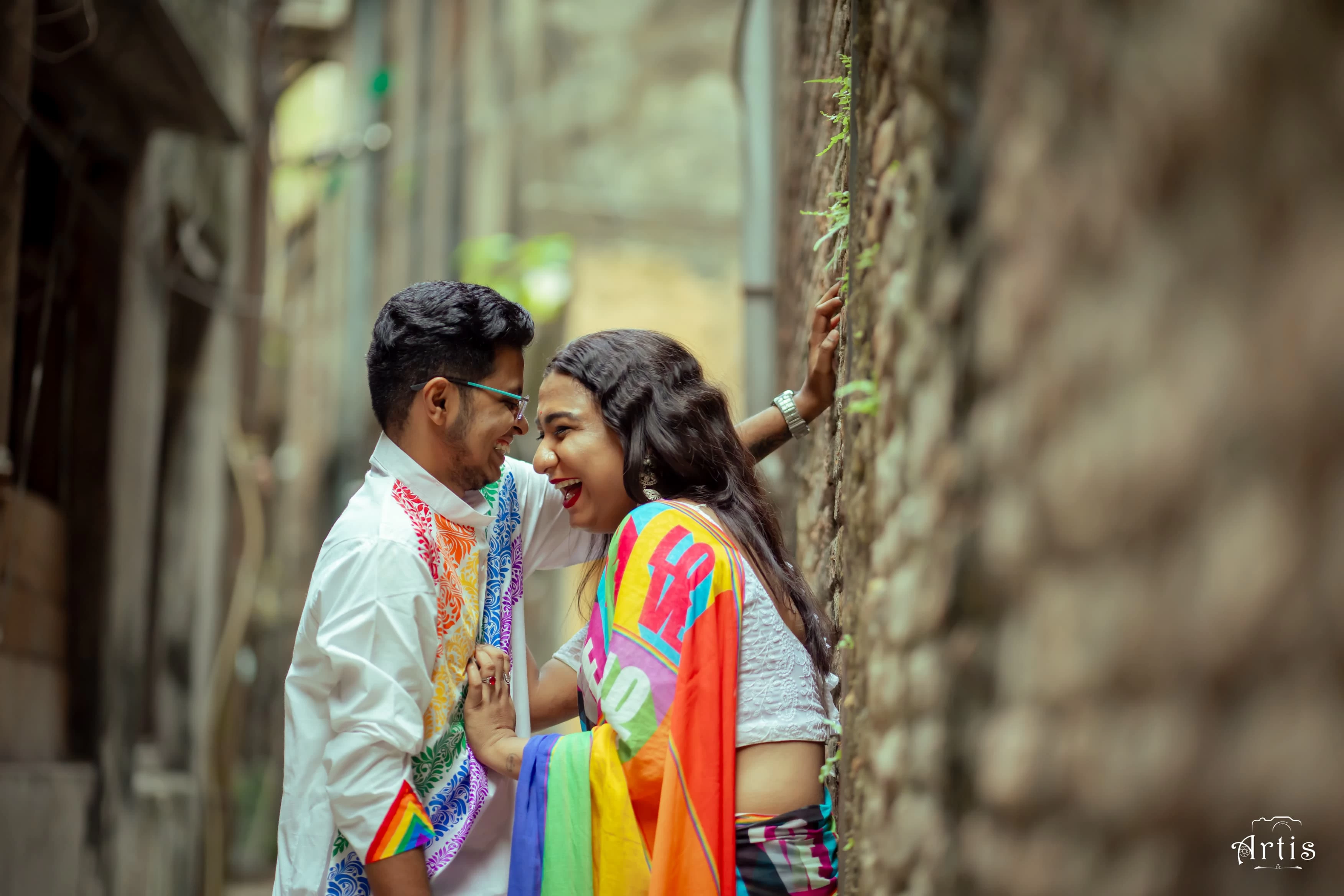
The couple didn’t hold back during their celebrations. Their pre-wedding shoot was a colourful tribute to the Pride flag. “We wore every shade of it. It was our way of saying pyaar kiya toh darna kya?” says Debangshi.

Their wedding pandal was adorned in pink, blue, and white, the colours of the transgender flag. It wasn’t just décor; it was defiance, hope, and joy wrapped in fabric.
Today, both Shaan and Debangshi work full-time jobs, but together, they run an organisation called TAS (Transgender Adhikar Sanghati Mancha), dedicated to supporting transgender individuals. “No one chooses to clap at traffic signals, beg, or turn to sex work,” says Debangshi. “People do it because society doesn’t give them options. We want to change that," said she determined to strive towards a more inclusive society.
Their marriage is a milestone, but they know the journey is far from over. “We want to build a world where people like us are not just tolerated, but accepted,” Shaan says. “Where our future generations don’t have to fight to exist.”
With sindoor in her hair and bangles jingling on her wrists, Debangshi smiles. “For the first time,” she says, “I have a family that thinks of me as their daughter. That’s all I ever wanted," she added, smiling coyly.