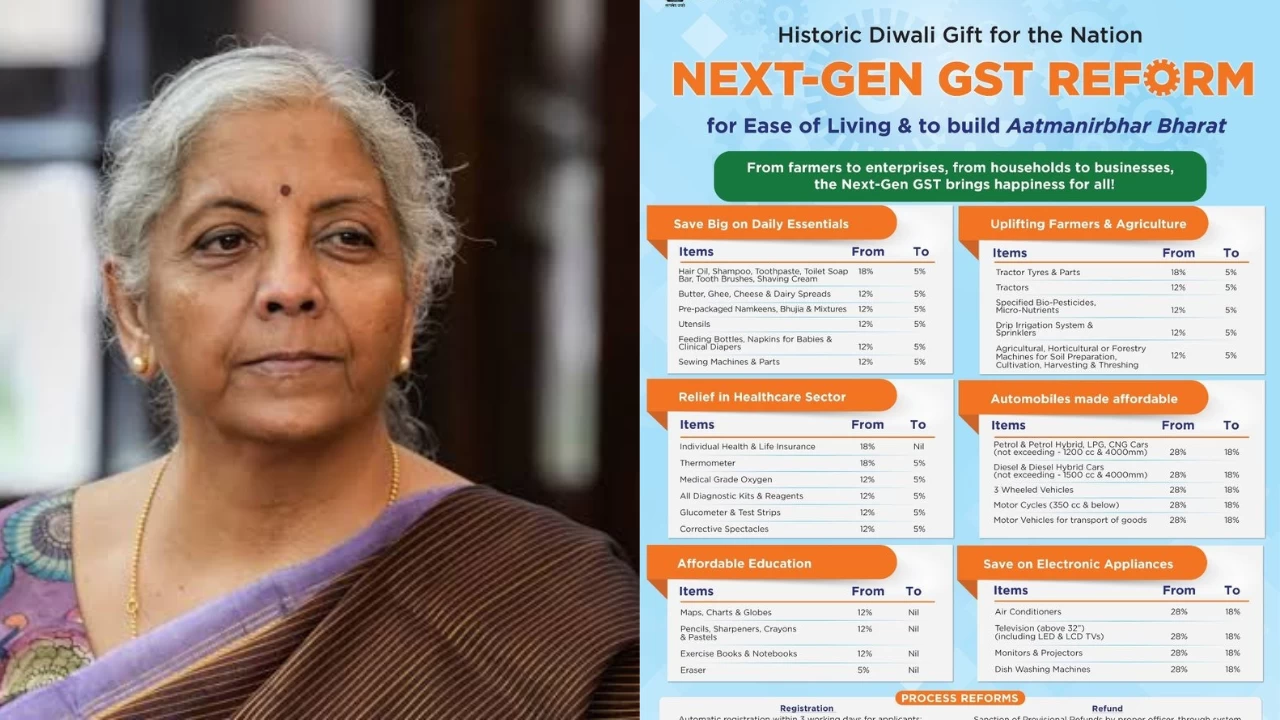
The GST Council headed by Union Finance Minister Nirmala Sitaraman, on Wednesday, approved a sweeping revision to the Goods and Services Tax rates. Following an extensive deliberation during its 56th meeting, Sitharaman unveiled the updates, highlighting their focus on supporting the average consumer, agricultural communities, and vital industries. PM Narendra Modi government hails it as ‘historic Diwali Gift’.
The overhaul transitions the existing multi-tiered GST framework - previously consisting of 5%, 12%, 18%, and 28% slabs into a more straightforward two-slab model. This includes a "merit rate" of 5% for essential and priority items, and a "standard rate" of 18% for most other goods and services. A separate "de-merit rate" of 40% has been introduced for luxury or harmful products, such as high-end vehicles and tobacco items, to discourage consumption while generating revenue. The new rates are set to roll out starting September 22, 2025, coinciding with the onset of festive seasons, though adjustments for tobacco and related products may follow separately.
Breaking Down the Slab Revisions
The revamp effectively eliminates the 12% and 28% brackets for the majority of items, redistributing them into the lower 5% or 18% categories. This shift is designed to correct inconsistencies in the tax structure, reduce inverted duties (where inputs are taxed higher than outputs), and make compliance easier for businesses. For instance:
- Goods formerly taxed at 12% will largely drop to 5%, benefiting labor-intensive and agricultural sectors.
- Higher-end items at 28% will now fall under 18%, providing relief to manufacturing and consumer durables.
- Select essentials will enjoy full exemption (0% rate), further lowering costs for households.
Experts anticipate this simplification will enhance economic efficiency, curb tax evasion, and stimulate demand in key areas like food, healthcare, and transportation.
Items Set for Lower Taxation
- Ultra-High Temperature (UHT) milk, prepackaged chena or paneer, and Indian flatbreads (like chapati, roti, paratha, and parotta): Previously 5%, now exempt (0%). This move aims to make basic nutrition more accessible.
- Packaged snacks and staples (namkeens, bhujia, pasta, instant noodles, cornflakes, biscuits, pastries, sugar confectionery, jam, fruit jellies, sausages, preserved meats, butter, ghee, dry nuts, condensed milk, fruit pulp or juice, milk-based drinks, ice cream, and tender coconut water): Down from 12% or 18% to 5%, easing costs for common grocery items.
- Daily essentials (hair oil, shampoo, toilet soap bars, talcum powder, face powder, toothpaste, toothbrushes, tooth powder, combs, feeding bottles, tableware, kitchenware, utensils, umbrellas, bicycles, and bamboo furniture): Reduced from 12% or 18% to 5%, offering savings on routine purchases.
Healthcare and Medicines
- Individual life and health insurance policies (including term life, ULIPs, endowments, family floaters, senior citizen plans, and their reinsurance): Now fully exempt (0%) from previous taxable status, promoting wider insurance adoption.
- Lifesaving drugs (33 specified medications like Agalsidase Beta, Imiglucerase, and Eptacog Alfa for rare diseases and cancer): From 12% or 5% to exempt (0%).
- Other medicines, medical devices, diagnostic kits, reagents, blood glucose monitors, wadding gauze, bandages, spectacles, and goggles for vision correction**: Dropped from 12%, 18%, or 28% to 5%, improving access to health services.
Agriculture and Related Equipment
- Farming machinery (tractors, soil preparation tools, harvesting and threshing equipment, fodder machines, composting machines, and soil harvesting machines): From 12% to 5%, aiding rural economies.
- Fertilizers and inputs (sulphuric acid, nitric acid, ammonia): Reduced from 18% to 5% to address duty inversions.
- Biopesticides (12 specified types): From 12%-18% to 5%.
Consumer Durables and Vehicles
- Electronics and appliances (air-conditioning machines, televisions up to 32 inches, dishwashing machines): From 28% to 18%.
- Vehicles (small cars under 1,200cc petrol or 1,500cc diesel and up to 4,000mm length, motorcycles up to 350cc, three-wheelers, buses, trucks, ambulances, and all auto parts): Uniformly cut from 28% to 18%.
- Cement: From 28% to 18%, benefiting construction.
Other Sectors
- Textiles (manmade fibres and yarns): From 18% or 12% to 5%.
- Renewable energy devices (windmills, bio-energy plants, PV cells, solar heaters, and parts): From 12% to 5%.
- Handicrafts, marble/granite/travertine blocks, and intermediate leather goods: From 12% to 5%.
- Hotel accommodations (up to Rs 7,500 per unit per day): From 12% to 5%.
Finance Minister Sitharaman noted that these measures reflect the government's commitment to inclusive growth, stating, "This GST 2.0 is about putting more money back into the pockets of the people while fostering sustainable development." Industry leaders have welcomed the changes, predicting a boost in consumer spending and manufacturing output.