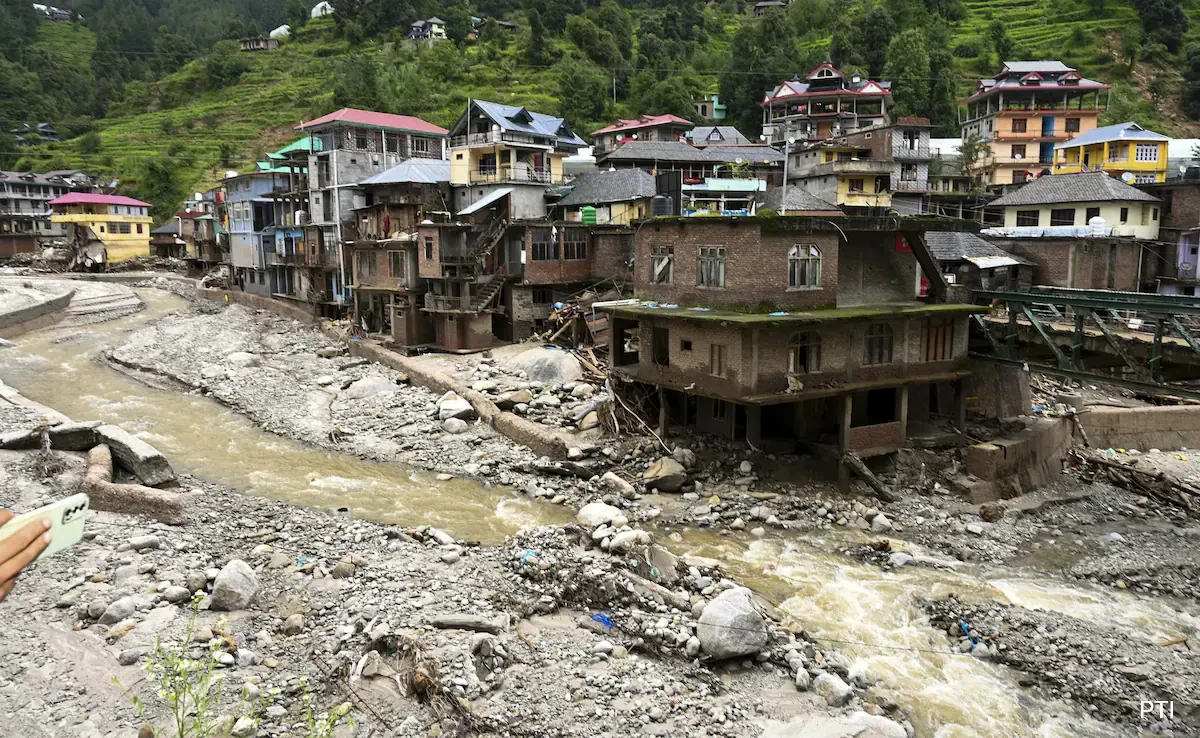
At least 78 people have lost their lives in Himachal Pradesh since the onset of the monsoon on June 20, as relentless rain, flash floods, and landslides continue to wreak havoc across the state.
According to the State Disaster Management Authority (SDMA), 50 of these deaths were the result of rain-related incidents, including flash floods, electrocutions, and drowning. A further 28 people were killed in road accidents linked to the deteriorating weather conditions.
The monsoon’s fury has also left 37 people missing and at least 115 others injured. As of 6 July, the state has recorded 23 flash floods, 19 cloudburst incidents, and 16 landslides, drastically altering the landscape and crippling infrastructure.
One of the worst-hit areas is Thunag in Mandi district, where the local branch of the Himachal Cooperative Bank has been reduced to rubble. The ground floor of the two-storey building is submerged and destroyed.
Widespread infrastructural damage has left much of the state paralysed. As of Sunday, 243 roads remain blocked, including two national highways. Over 278 electricity transformers are non-functional, and 261 water supply projects have also been disrupted.
In response to the situation, the India Meteorological Department (IMD) has issued a red alert for heavy to very heavy rainfall in Mandi, Kangra, and Sirmaur districts, with an orange alert in effect across Shimla, Solan, Hamirpur, Bilaspur, Una, Kullu, and Chamba.
The IMD has also warned of “very heavy rain, thunderstorm and lightning, squall” through the next few days, with heavy rain specifically predicted for 8 and 9 July.
Neighbouring Uttarakhand is facing its own crisis, with the Geological Survey of India issuing a landslide warning for four districts: Tehri, Uttarkashi, Rudraprayag, and Chamoli. The advisory, effective for 7 and 8 July, highlights risk in several subdivisions including Ukhimath, Ghansali, Dunda, and Dhanaulti.
In light of the escalating crisis, the State Emergency Operations Centre (SEOC) has instructed all district magistrates, police, disaster management authorities, and the State Disaster Response Force (SDRF) to remain on maximum alert.
Disaster Management Incident Response System (IRS) officers, as well as local officials such as Revenue Sub Inspectors and Gram Panchayat Officers, have been ordered to stay stationed in their areas with communication lines open at all times.
Officials have been told to ensure that all emergency equipment, including JCB and Pokland machines, along with wireless sets, remain operational and ready for deployment.
Tourist movement to higher Himalayan regions has been restricted. Both vehicle and pedestrian travel are to be suspended during heavy rainfall periods to prevent further loss of life.